
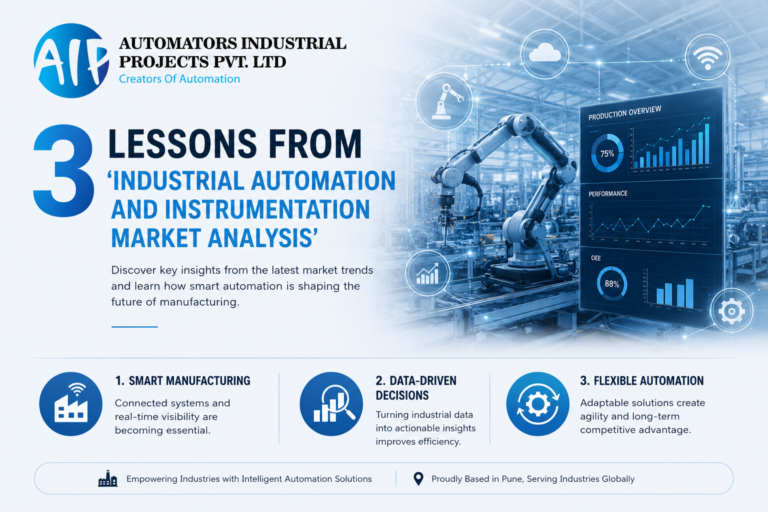
3 Lessons From 'Industrial Automation And Instrumentation Market Analysis
Industrial automation solutions provider
Industrial Automation and Instrumentation| Industrial Automation Solutions | Industry 4.0 | Industrial IoT Solutions
In today’s rapidly evolving industrial landscape, automation is no longer limited to improving production speed. Industries are increasingly focusing on connected systems, data-driven decision-making, predictive maintenance, intelligent monitoring, and operational efficiency.
According to recent Industrial Automation and Instrumentation Market Analysis reports, the global market continues to expand rapidly due to increasing demand for smart manufacturing, Industrial IoT (IIoT), AI-powered systems, and digital transformation initiatives.
For manufacturers, plant heads, and industrial decision-makers, these market trends provide valuable insights into where modern industries are heading.
As a leading industrial automation company in Pune, Automators Industrial Projects Private Limited (AIPPAL) helps industries implement modern PLC, SCADA, HMI, MES, and smart manufacturing technologies that align with Industry 4.0 requirements.
Key Takeaways
✓ Understand what current Industrial Automation and Instrumentation market trends reveal
✓ Learn why industries are rapidly investing in smart manufacturing
✓ Discover 3 major lessons manufacturers can apply immediately
✓ Understand how connected automation improves productivity and visibility
✓ Explore how industrial automation solutions support future growth
Table of Contents
1.Quick Overview of the Industrial Automation and Instrumentation Market
Recent market studies indicate strong growth in Industrial Automation and Instrumentation due to several factors:
- Increasing adoption of Industry 4.0
- Growing implementation of Industrial IoT systems
- Rising demand for predictive maintenance
- Increased focus on operational efficiency
- Expansion of AI-based manufacturing systems
- Greater adoption of robotics and smart sensors
- Need for real-time monitoring and analytics
Modern industries are shifting from traditional manufacturing systems toward intelligent and connected ecosystems.
2.Why This Market Growth Matters
Many industries still operate with disconnected systems and limited production visibility.
This often creates challenges such as:
- Unexpected equipment failures
- Delayed troubleshooting
- Manual reporting processes
- Production inefficiencies
- Higher operational costs
- Limited machine connectivity
- Inconsistent product quality
The growing automation market highlights an important reality:
Industries investing in smarter systems are gaining significant operational advantages.
3.Lesson 1: Smart Manufacturing Is Becoming Essential
One of the strongest signals from the market analysis is the rapid adoption of smart manufacturing systems.
Traditional manufacturing environments often rely on:
- Manual data collection
- Independent machine operations
- Separate control systems
- Limited operational insights
Smart manufacturing enables:
- Machine-to-machine communication
- Real-time monitoring
- Centralized dashboards
- Improved production visibility
- Faster issue identification
- Better decision-making
Connected manufacturing environments help industries improve productivity and reduce downtime.
4.Lesson 2: Data-Driven Decisions Improve Efficiency
Industrial automation is increasingly shifting toward data intelligence.
Modern factories generate large volumes of production data every day.
When analyzed properly, this data helps industries:
Reduce Downtime
Real-time monitoring identifies problems early.
Improve Production Planning
Data helps optimize machine utilization.
Enable Predictive Maintenance
Equipment issues can be identified before failures occur.
Improve Product Quality
Analytics helps identify process variations quickly.
Industries that effectively use operational data often achieve greater efficiency and cost savings.
5.Lesson 3: Flexible Automation Creates Competitive Advantage
Manufacturing demands continue changing rapidly.
Industries increasingly require:
- Smaller production batches
- Multiple product variants
- Faster product launches
- Customized manufacturing processes
- Scalable systems
Traditional rigid automation systems struggle to meet these demands.
Flexible automation offers:
- Faster changeovers
- Better machine utilization
- Easy scalability
- Lower operational bottlenecks
- Easier future upgrades
Companies adopting flexible systems today are better prepared for future market changes.
6.What This Means for Manufacturers
For industrial leaders, these trends directly impact daily operations.
Key benefits include:
Better Production Visibility
Real-time dashboards provide actionable insights.
Faster Troubleshooting
Connected systems identify issues quickly.
Lower Manual Errors
Automation reduces repetitive manual processes.
Smarter Maintenance Planning
Predictive systems reduce unexpected failures.
Improved Operational Efficiency
Integrated systems streamline production workflows.
7.Emerging Trends to Watch
The industrial automation market continues evolving rapidly.
Important trends include:
- AI-driven manufacturing analytics
- Industrial IoT integration
- Cloud-based monitoring systems
- Smart quality inspection
- Robotics and machine vision
- Energy management automation
- Digital twin technologies
- MES implementation
Industries that adopt these technologies early may gain stronger competitive advantages.
8.Practical Steps Industries Can Take Today
Manufacturers do not need complete transformation overnight.
Practical starting points include:
Evaluate Existing Challenges
Identify operational bottlenecks and downtime causes.
Improve Machine Connectivity
Integrate PLC, SCADA, and monitoring systems.
Centralize Data Visibility
Implement real-time dashboards.
Assess Industry 4.0 Readiness
Review current automation capabilities.
Work with Experienced Automation Partners
Proper planning reduces implementation risks.
9.How AIPPAL Supports Smart Manufacturing
Automators Industrial Projects Private Limited (AIPPAL) delivers advanced industrial automation solutions for modern industries.
Services include:
- PLC Programming and Commissioning
- SCADA and HMI Development
- MES Solutions
- Industrial IoT Integration
- AI-based Industrial Analytics
- Electrical Design and Panel Manufacturing
- Conveyor Automation Systems
- Smart Manufacturing Solutions
AIPPAL supports industries in building scalable, connected, and future-ready manufacturing environments.
Final Thoughts
The latest Industrial Automation and Instrumentation Market Analysis sends a clear message:
Future manufacturing will increasingly depend on:
- Connected industrial systems
- Intelligent automation
- Data-driven operations
- Flexible manufacturing systems
- Real-time visibility
Industries that begin strengthening automation and production intelligence today will be better prepared for long-term growth and competitiveness.
FAQs
1. What is Industrial Automation and Instrumentation?
Industrial Automation and Instrumentation involves using control systems, sensors, PLCs, SCADA, and software technologies to improve industrial operations and productivity.
2. Why is Industrial Automation important?
Automation improves efficiency, reduces downtime, enhances safety, and increases production quality.
3. What industries benefit from automation systems?
Automotive, pharmaceuticals, manufacturing, food processing, warehouse automation, and process industries benefit significantly.
4. What is Industry 4.0?
Industry 4.0 refers to smart manufacturing using IoT, AI, cloud systems, and connected industrial technologies.
5. Why choose AIPPAL for industrial automation solutions?
AIPPAL provides expertise in PLC, SCADA, MES, Industrial IoT, and smart manufacturing technologies to improve operational efficiency.