
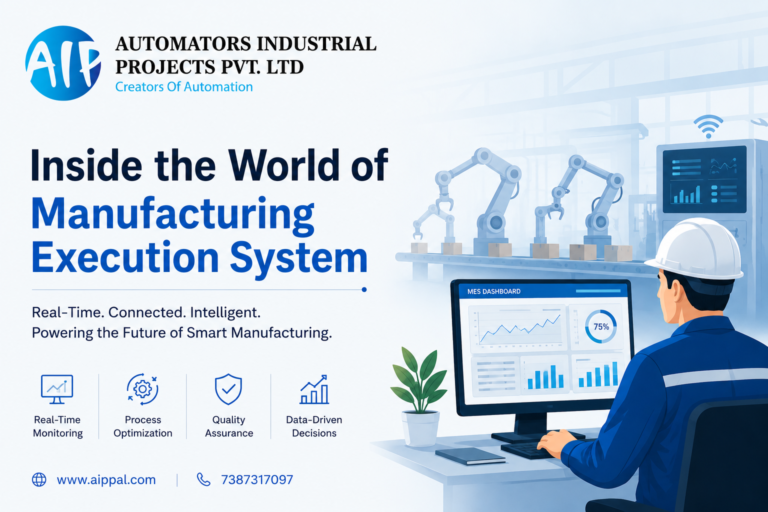
Inside the World of Manufacturing Execution System
Industrial automation solutions provider
Manufacturing Execution System | MES Software | Smart Manufacturing Solutions
In today’s highly competitive industrial environment, manufacturers are under constant pressure to improve productivity, maintain product quality, reduce downtime, and deliver products faster than ever before. Traditional production methods and manual tracking systems are no longer sufficient for modern manufacturing operations. Industries now require intelligent systems that provide real-time production visibility, accurate data tracking, and better coordination between machines, operators, and management teams.
This is where a Manufacturing Execution System (MES) becomes highly important.
A Manufacturing Execution System acts as the digital bridge between the factory floor and enterprise-level business systems. It helps industries monitor, track, control, and optimize manufacturing processes in real time. From production scheduling and machine monitoring to quality control and performance analysis, MES software helps businesses achieve greater operational efficiency and smarter manufacturing operations.
Whether it’s automotive manufacturing, pharmaceuticals, food processing, electronics, packaging, or heavy industries, MES solutions are transforming how factories operate in the era of Industry 4.0 and smart manufacturing.
As an industrial automation solutions provider, AIP helps businesses implement scalable Manufacturing Execution System solutions that improve operational visibility, production control, and long-term industrial growth.
Key Takeaways
✓ Understand what a Manufacturing Execution System is
✓ Learn how MES software improves manufacturing operations
✓ Discover the role of MES in smart manufacturing
✓ Explore the benefits of real-time production monitoring
✓ Understand how MES supports Industry 4.0 transformation
Table of Contents
1.What Is a Manufacturing Execution System
A Manufacturing Execution System (MES) is a software-based solution designed to monitor, control, track, and optimize manufacturing operations in real time. It acts as a centralized system that connects production equipment, operators, machines, sensors, and enterprise systems into one intelligent manufacturing environment.
In simple terms, MES software tracks manufacturing activities on the factory floor, provides real-time production data and operational insights, and helps manufacturers improve productivity, quality, and efficiency.
Instead of relying on paper-based records or disconnected systems, industries can use a Manufacturing Execution System to gain complete visibility into production operations from start to finish.
For example, production managers can instantly monitor machine performance, production status, inventory flow, and quality metrics through centralized MES dashboards.
This is why Manufacturing Execution Systems are becoming a critical part of modern industrial automation and smart manufacturing environments.
2.Understanding MES Software in Manufacturing
MES software plays a major role in helping industries digitize and streamline manufacturing operations. It serves as the operational layer between enterprise-level planning systems like ERP software and the physical production environment on the factory floor.
Modern MES software helps manufacturers monitor production processes in real time, track raw materials and finished products, manage production schedules, improve quality control, reduce production delays, optimize machine utilization, and maintain production records and compliance.
One of the biggest advantages of MES software is its ability to provide accurate, real-time production information that helps businesses make faster and smarter decisions.
By replacing manual tracking systems with digital manufacturing intelligence, MES solutions help industries improve operational consistency, reduce waste, and increase overall production efficiency.
3.Core Functions of a Manufacturing Execution System
Execution System
A Manufacturing Execution System supports multiple critical manufacturing functions.
Production Monitoring
MES tracks machine operations, production output, and process performance continuously.
Work Order Management
The system helps manage production orders, scheduling, and workflow execution.
Quality Control
MES software monitors quality standards and detects production defects early.
Inventory Tracking
Manufacturers can track raw materials, work-in-progress items, and finished goods in real time.
Machine Performance Monitoring
MES systems analyze machine efficiency, downtime, and operational performance.
Data Collection and Reporting
The system collects production data and generates detailed performance reports for analysis.
These functions help industries create more organized, connected, and efficient production environments.
4.How MES Connects the Factory Floor
One of the biggest strengths of a Manufacturing Execution System is its ability to connect various manufacturing components into one centralized platform.
Machines and sensors collect production data, while PLCs and automation systems process machine operations. MES software gathers operational information and displays it through centralized dashboards where managers and operators can monitor production activities in real time.
This creates a connected manufacturing ecosystem where data flows smoothly between machines, operators, and management teams.
For example, if a machine experiences abnormal downtime, the MES system can instantly notify operators, record the issue, and provide performance data for troubleshooting and maintenance planning.
This improves operational control, productivity, and manufacturing efficiency.
5.Why Industries Are Adopting MES Solutions
Industries today face growing pressure to improve production efficiency while maintaining high quality standards and reducing operational costs.
Manufacturing Execution Systems help businesses solve these challenges by providing real-time visibility and smarter production management capabilities.
Key reasons industries are adopting MES solutions include the need for real-time production monitoring, better production planning and scheduling, reduced manual errors and paperwork, improved product traceability, faster problem identification, increased operational efficiency, better quality management, and enhanced decision-making using production data.
As industries move toward digital transformation and smart manufacturing, MES software is becoming essential for staying competitive.
6.Benefits of Manufacturing Execution Systems
Modern Manufacturing Execution Systems offer several important operational advantages.
Improved Operational Efficiency
MES software helps optimize workflows and reduce production bottlenecks.
Reduced Downtime
Real-time machine monitoring helps maintenance teams respond quickly to issues.
Better Product Quality
Manufacturers can maintain consistent quality standards through automated monitoring.
Increased Production Visibility
Managers gain complete visibility into factory operations and production status.
Real-Time Data Access
Production data is instantly available for analysis and reporting.
Improved Traceability
MES systems help track products, materials, and production activities throughout the manufacturing process.
Scalability
MES solutions can expand alongside growing production requirements.
These benefits help industries build smarter, more efficient, and more connected manufacturing operations.
7.Real-Time Production Monitoring and Visibility
Real-time production visibility is one of the most valuable features of a Manufacturing Execution System.
Operators and managers can monitor machine performance, production output, downtime events, production efficiency, product quality, inventory movement, equipment health, and alarm conditions in real time.
This level of visibility helps industries identify operational problems before they become major production issues.
Real-time monitoring also supports predictive maintenance strategies by helping businesses detect machine abnormalities early.
As a result, manufacturers can reduce unexpected downtime and improve overall equipment effectiveness (OEE).
8.Industries Using Manufacturing Execution Systems
Manufacturing Execution Systems are widely used across multiple industrial sectors.
Automotive Industry
MES supports production line monitoring, assembly tracking, and quality management.
Food and Beverage Industry
It helps with batch tracking, packaging monitoring, and compliance management.
Pharmaceutical Industry
MES solutions support regulatory compliance, production traceability, and quality assurance.
Electronics Manufacturing
Manufacturers use MES for component tracking, precision production monitoring, and process optimization.
Oil and Gas Industry
MES assists with process monitoring, equipment performance analysis, and safety monitoring.
Heavy Manufacturing Industry
Industries use MES for machine utilization tracking, workflow optimization, and production scheduling.
The flexibility of MES solutions makes them suitable for almost every modern manufacturing environment.
9.Common Challenges in MES Implementation
While Manufacturing Execution Systems offer major benefits, implementation can sometimes be complex.
Common challenges include integration with legacy machines, data synchronization issues, high initial setup complexity, employee training requirements, cybersecurity concerns, network infrastructure limitations, and managing large volumes of production data.
This is why industries often work with experienced industrial automation solution providers to ensure smooth MES implementation and integration.
10.How AIP Supports MES Solutions
AIP provides end-to-end Manufacturing Execution System solutions designed around real industrial requirements.
The company supports MES software integration, industrial automation connectivity, real-time production monitoring, PLC and SCADA integration, machine communication systems, industrial data visualization, smart manufacturing solutions, and production performance optimization.
By focusing on scalable and intelligent automation strategies, AIP helps businesses improve operational visibility, production efficiency, and manufacturing performance.
11.Future of Manufacturing Execution Systems
The future of manufacturing is becoming increasingly digital, intelligent, and data-driven.
Modern Manufacturing Execution Systems are evolving alongside technologies such as Industrial IoT, cloud-based manufacturing platforms, AI-driven production analytics, predictive maintenance, smart factory systems, digital twins, and advanced industrial automation.
Future factories will rely heavily on real-time manufacturing intelligence where machines, software systems, and operators work together seamlessly.
MES software will continue to play a major role in enabling connected and intelligent industrial environments.
12.Getting Started with MES Implementation
Businesses planning to implement a Manufacturing Execution System should first evaluate their current production challenges, existing machine infrastructure, automation and monitoring goals, production workflow requirements, data collection needs, and future scalability requirements.
A phased implementation approach often delivers the best long-term results for MES integration projects.
Careful planning and proper system integration help industries maximize the value of MES software and improve operational performance successfully.
Final Thoughts
Manufacturing Execution Systems are transforming modern industrial operations by helping businesses achieve smarter, faster, and more connected manufacturing processes.
By combining real-time production monitoring, data-driven decision-making, and intelligent workflow management, MES software helps industries improve productivity, reduce downtime, enhance quality, and optimize overall manufacturing performance.
As industries continue moving toward Industry 4.0 and smart manufacturing, MES solutions will become increasingly important for building future-ready production environments.
For businesses beginning their digital transformation journey, understanding Manufacturing Execution Systems is one of the most important steps toward achieving long-term manufacturing efficiency and operational excellence.
FAQs
1. What is a Manufacturing Execution System?
A Manufacturing Execution System (MES) is a software solution that monitors, tracks, controls, and optimizes manufacturing operations in real time.
2. What are the benefits of MES software?
MES software helps improve production efficiency, reduce downtime, increase quality control, and provide real-time production visibility.
3. Which industries use Manufacturing Execution Systems?
Industries such as automotive, pharmaceuticals, food processing, electronics, oil and gas, and heavy manufacturing widely use MES solutions.
4. How does MES support smart manufacturing?
MES systems support smart manufacturing by connecting machines, operators, and production data into one centralized and intelligent manufacturing environment.