
3 Lessons From ‘Rockwell Automation Unveils Digital Manufacturing Innovations at Interpack 2026’
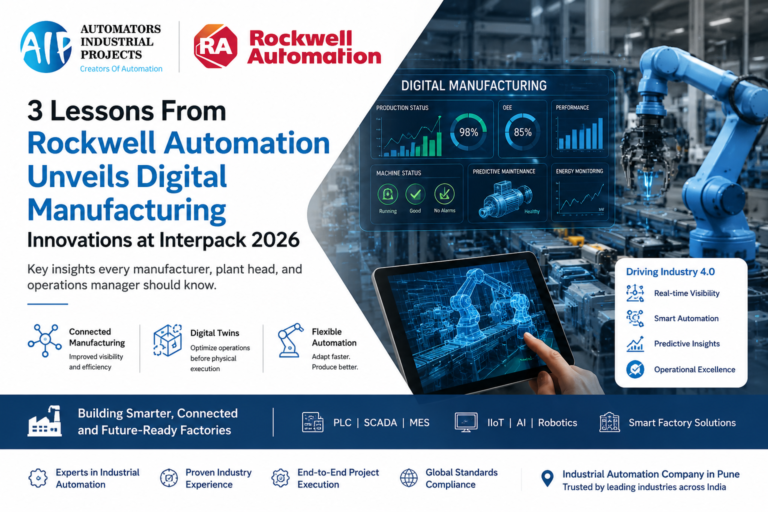
Industrial automation solutions provider
rockwell automation unveils digital manufacturing | industrial automation company in pune | Digital manufacturing
In today’s rapidly evolving industrial landscape, manufacturers are no longer focusing only on production speed. Industries now demand connected systems, real-time visibility, flexible automation, predictive maintenance, and smarter operational control. This is why the recent announcement from Rockwell Automation at Interpack 2026 has gained significant attention across the industrial automation sector.
The event highlighted how digital manufacturing, integrated engineering, robotics, and automation platforms are transforming the future of industrial production. For manufacturers, OEMs, plant heads, and operations managers, the announcement provides valuable insights into where industrial automation is heading next.
As a leading industrial automation company in Pune, Automators Industrial Projects Private Limited (AIP) helps industries adopt modern PLC, SCADA, MES, AI-driven monitoring, and smart manufacturing technologies that align with Industry 4.0 requirements.
Key Takeaways
✓ Understand what Rockwell Automation showcased at Interpack 2026
✓ Learn why connected digital manufacturing matters now
✓ Discover 3 important lessons industries can apply immediately
✓ Explore how smart automation improves productivity and operational visibility
✓ Understand how industrial automation companies in Pune are supporting Industry 4.0 transformation
Table of Contents
1.Quick Recap: What Rockwell Automation Unveiled at Interpack 2026
At Interpack 2026, Rockwell Automation demonstrated an integrated digital manufacturing ecosystem focused on improving engineering collaboration, automation flexibility, robotics integration, and production visibility.
The showcase included:
- Digital engineering workflows
- Integrated PLC and automation systems
- Robotics and motion control
- Digital twin technologies
- Real-time production monitoring
- Modular manufacturing architectures
- Smart factory connectivity
The core idea behind the demonstration was simple: future manufacturing systems must be connected, scalable, flexible, and data-driven.
Instead of operating machines, engineering systems, and production monitoring separately, manufacturers are moving toward fully integrated industrial automation ecosystems.
2.Why This Matters More Than Most Manufacturers Realize
Many factories still operate with disconnected production systems and limited operational visibility.
This creates several challenges:
- Unplanned downtime
- Delayed troubleshooting
- Manual reporting processes
- Inconsistent product quality
- Limited production analytics
- Higher operational costs
- Poor machine connectivity
The technologies highlighted at Interpack 2026 directly address these problems.
Today’s industries are rapidly moving toward:
- Smart manufacturing
- Real-time industrial monitoring
- AI-based analytics
- Industrial IoT integration
- Predictive maintenance
- Flexible production systems
- Industry 4.0 automation
For sectors like pharmaceuticals, automotive, food processing, packaging, and warehouse automation, connected manufacturing is becoming a competitive necessity.
3.Lesson 1: Connected Manufacturing Is Becoming Essential
One of the biggest lessons from the Rockwell Automation showcase is that isolated production systems are no longer sustainable for modern manufacturing.
Traditional factories often operate with:
- Separate machine controls
- Independent engineering teams
- Manual production tracking
- Limited operational data visibility
This reduces efficiency and increases downtime risks.
Connected manufacturing systems solve this problem by enabling:
- Machine-to-machine communication
- Centralized production monitoring
- Shared industrial data systems
- Faster issue detection
- Improved production coordination
- Better operational transparency
For factory owners and operations managers, connected systems improve production efficiency and decision-making.
For QA managers in pharmaceutical industries, connected automation systems improve traceability, compliance, and production consistency.
As one of the growing industrial automation companies in Pune, AIP supports manufacturers with PLC SCADA integration, machine connectivity, MES systems, and real-time industrial dashboards designed for smarter production environments.
4.Lesson 2: Digital Twins Are Transforming Industrial Operations
Digital twin technology was one of the key highlights at Interpack 2026.
A digital twin is a virtual simulation of a machine, process, or production line that allows industries to test and optimize operations before physical deployment.
This technology provides several advantages:
Faster Commissioning
Manufacturers can test production logic virtually before installation.
Reduced Downtime
Operational issues can be identified before affecting live production.
Improved Production Planning
Factories can simulate production scenarios and optimize workflows.
Lower Expansion Risks
New production lines can be validated digitally before implementation.
Digital twin technology is becoming increasingly valuable for OEMs, automotive manufacturers, and smart factories looking to improve efficiency and reduce project risks.
AIP supports industries with modern industrial automation solutions including PLC, SCADA, MES, and AI-driven operational analytics that align with future-ready smart manufacturing strategies.
5.Lesson 3: Flexible Automation Will Define Future Factories
Consumer demands and manufacturing requirements are changing rapidly.
Industries now need to support:
- Multiple product variants
- Smaller production batches
- Faster product launches
- Customized packaging
- Frequent operational changes
Traditional rigid automation systems struggle to handle this level of flexibility.
The Interpack 2026 showcase highlighted modular and flexible automation systems capable of adapting quickly to changing production needs.
Flexible automation provides:
- Faster product changeovers
- Better machine utilization
- Scalable production systems
- Easier future upgrades
- Reduced operational bottlenecks
Industries that adopt flexible automation early will be better prepared for changing market demands and Industry 4.0 transformation.
6.What This Means for Factory Owners and Plant Heads
For industrial decision-makers, these developments directly impact day-to-day operations.
Key benefits include:
Better Production Visibility
Real-time dashboards provide instant operational insights.
Faster Troubleshooting
Connected systems identify faults more quickly.
Reduced Manual Errors
Automation reduces dependency on repetitive manual tasks.
Improved Compliance Monitoring
Industries like pharmaceuticals benefit from better process traceability.
Smarter Maintenance Planning
Predictive maintenance reduces unexpected failures.
These improvements help industries increase productivity while lowering operational risks and costs.
7.What to Watch for Next in Industrial Automation
The technologies presented at Interpack 2026 are part of a much larger industrial transformation.
Key trends manufacturers should monitor include:
- AI-driven manufacturing analytics
- Industrial IoT systems
- Cloud-based production monitoring
- Predictive maintenance platforms
- Robotics integration
- Smart quality inspection systems
- Energy management automation
- MES and digital manufacturing systems
Industries that adopt these technologies early will likely gain stronger operational advantages in the coming years.
8.Practical Steps Manufacturers Can Take This Week
Manufacturers do not need to completely modernize their factories overnight.
Practical starting points include:
Evaluate Current Production Challenges
Identify downtime causes and operational inefficiencies.
Improve Machine Connectivity
Start integrating PLC, SCADA, and monitoring systems.
Centralize Operational Visibility
Implement dashboards for real-time production monitoring.
Review Automation Readiness
Assess existing infrastructure for Industry 4.0 compatibility.
Work With Experienced Automation Experts
Proper planning reduces integration risks and improves implementation efficiency.
Even small automation improvements can create significant operational benefits over time.
9.How Automators Industrial Projects Private Limited (AIP) Supports Smart Manufacturing
Automators Industrial Projects Private Limited (AIP) is a leading industrial automation company in Pune specializing in PLC, SCADA, HMI, MES, AI-based analytics, and smart factory automation solutions.
AIP supports industries through:
- PLC programming and commissioning
- SCADA and HMI development
- MES and machine connectivity
- AI-based industrial solutions
- Energy management systems
- Industrial IoT integration
- Electrical design and panel manufacturing
- Conveyor and material handling automation
The company has worked across automotive, process automation, warehouse automation, and smart factory projects while supporting global industrial standards including INTEGRA and TMO frameworks.
With expertise in no-code and low-code industrial automation development, AIP helps industries reduce commissioning time, improve operational visibility, and build scalable smart manufacturing environments.
Final Thoughts
The announcement around “Rockwell Automation Unveils Digital Manufacturing Innovations at Interpack 2026” highlights the direction modern manufacturing is heading toward.
Future factories will increasingly rely on:
- Connected industrial systems
- Flexible automation
- Digital engineering
- Real-time operational visibility
- AI-driven manufacturing intelligence
For manufacturers, OEMs, plant heads, and operations managers, the message is clear: smart manufacturing is no longer optional for long-term competitiveness.
Industries that begin improving automation, connectivity, and production intelligence today will be better prepared for the future of industrial manufacturing.
FAQs
1. What did Rockwell Automation showcase at Interpack 2026?
Rockwell Automation showcased connected digital manufacturing technologies including robotics, digital twins, integrated automation systems, and smart production workflows.
2. Why is connected manufacturing important?
Connected manufacturing improves production visibility, operational efficiency, troubleshooting speed, and overall manufacturing performance.
3. What is a digital twin in industrial automation?
A digital twin is a virtual model of a machine or production system used for testing, monitoring, and operational optimization.
4. Which industries benefit from smart automation systems?
Industries including automotive, pharmaceuticals, food processing, packaging, warehouse automation, and manufacturing benefit from smart automation solutions.
5. Why choose an industrial automation company in Pune like AIP?
Companies like Automators Industrial Projects Private Limited provide expertise in PLC, SCADA, MES, AI-driven automation, and Industry 4.0 solutions that help industries improve productivity and operational efficiency.