
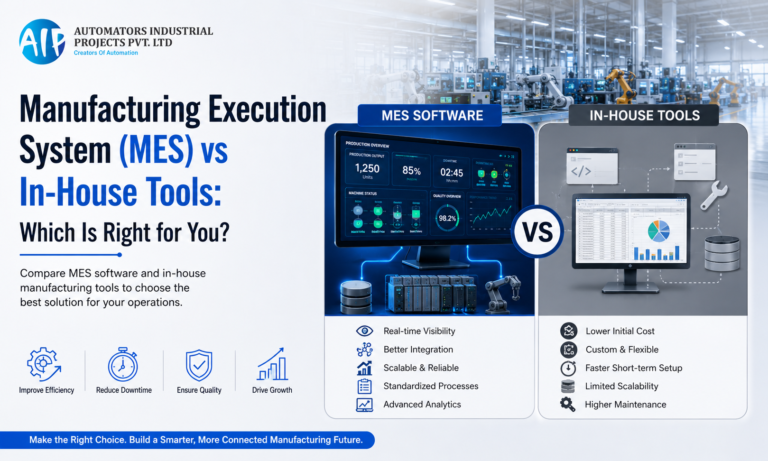
Manufacturing Execution System MES vs In-House Tools: Which Is Right for You?
Industrial automation solutions provider
Manufacturing Execution System | manufacturing operations | MES software
Modern manufacturing is becoming more data-driven, connected, and performance-focused than ever before. Industries today need systems that can track production, monitor machines, manage workflows, and improve operational visibility in real time.
To achieve this, many businesses face a critical decision: should they invest in a Manufacturing Execution System (MES) or continue using internally developed in-house tools?
Both approaches can support manufacturing operations, but they differ significantly in scalability, flexibility, implementation complexity, maintenance requirements, and long-term business value. While some companies rely on spreadsheets, custom dashboards, and internally built applications, others are adopting advanced MES software to create connected and intelligent manufacturing environments.
Understanding the difference between MES platforms and in-house manufacturing tools is important for businesses planning digital transformation and smart manufacturing initiatives.
As an industrial automation solutions provider, AIP helps industries evaluate, implement, and optimize manufacturing execution solutions that align with operational goals and future scalability needs.
Key Takeaways
✓ Understand what a Manufacturing Execution System (MES) is
✓ Learn how in-house manufacturing tools work
✓ Compare MES software with custom-built internal systems
✓ Explore the advantages and limitations of both approaches
✓ Understand which solution fits different business requirements
✓ Learn how MES supports Industry 4.0 and smart manufacturing
Table of Contents
1.What Is a Manufacturing Execution System MES
A Manufacturing Execution System (MES) is a software platform that helps manufacturers monitor, control, track, and optimize production operations in real time.
MES software acts as a bridge between shop-floor operations and enterprise-level business systems such as ERP platforms. It collects live production data from machines, operators, sensors, PLCs, and industrial equipment to provide complete operational visibility.
Manufacturing Execution Systems are commonly used for:
- Production monitoring
- Work order management
- Quality tracking
- Machine performance analysis
- Production scheduling
- Material traceability
- Downtime monitoring
- Real-time reporting
An MES helps industries improve productivity, maintain product quality, reduce operational delays, and make better manufacturing decisions based on real-time data.
2.Understanding In-House Manufacturing Tools
In-house manufacturing tools are internally developed systems created by a company’s own IT or engineering teams to manage specific production activities.
These tools may include:
- Excel-based tracking systems
- Custom dashboards
- Production monitoring applications
- Internal reporting software
- Machine logging systems
- Custom databases
- Manual workflow management tools
Many businesses initially use in-house tools because they are quick to develop, cost-effective for small operations, and tailored to specific workflows.
However, as production complexity increases, internally developed systems can become difficult to scale, maintain, and integrate with modern industrial technologies.
3.How MES Software Works
MES software connects directly with production systems, machines, PLCs, sensors, and enterprise applications to create a centralized manufacturing management platform.
The MES workflow typically includes:
- Collecting production data from machines
- Monitoring manufacturing processes in real time
- Tracking operator activities
- Managing production orders
- Recording quality information
- Generating live reports and analytics
- Sending alerts for production issues
- Integrating with ERP and SCADA systems
This creates a connected manufacturing ecosystem where management teams gain complete visibility into production performance and operational efficiency.
For example:
If a production machine stops unexpectedly, the MES system can instantly record downtime, notify operators, track production loss, and generate maintenance alerts automatically.
4.Why Businesses Use In-House Manufacturing Tools
Many industries continue using internally developed manufacturing systems for practical reasons.
Common reasons include:
- Lower initial investment
- Existing internal expertise
- Simpler operational requirements
- Faster short-term deployment
- Highly customized workflows
- Limited production scale
Small manufacturing units often prefer in-house tools because they can solve immediate operational problems without requiring large-scale MES implementation.
However, these systems may face limitations when businesses expand production, add new plants, or adopt smart manufacturing strategies.
5.MES vs In-House Tools: Major Differences
Scalability
MES software is designed for long-term scalability across multiple production lines, plants, and facilities.In-house tools may struggle when production complexity increases.
Integration Capabilities
MES platforms support integration with:
- ERP systems
- PLC automation
- SCADA systems
- Industrial IoT devices
- Quality management systems
In-house systems often require additional custom development for integrations.
Real-Time Visibility
MES software provides centralized and real-time production monitoring.
Many in-house tools rely heavily on manual data entry or delayed reporting processes.
Maintenance and Support
MES vendors provide regular updates, cybersecurity improvements, and technical support.
Internal tools depend completely on internal development teams for maintenance and troubleshooting.
Standardization
MES platforms follow industrial best practices and standardized workflows.
In-house tools are usually highly customized but may lack process consistency across departments.
6.Advantages of Manufacturing Execution Systems
Improved Production Visibility
MES systems provide complete real-time visibility into manufacturing operations.
Better Data Accuracy
Automated data collection reduces manual errors and improves reporting reliability.
Enhanced Quality Control
MES software helps track defects, maintain compliance, and improve product consistency.
Faster Decision-Making
Managers gain access to live production insights for faster operational decisions.
Increased Productivity
Manufacturers can identify bottlenecks and improve machine utilization.
Regulatory Compliance
MES systems help industries maintain audit trails, traceability, and compliance documentation.
Industry 4.0 Readiness
Modern MES platforms support smart manufacturing, IoT connectivity, and advanced analytics.
7.Benefits of In-House Manufacturing Tools
In-house tools can still offer valuable benefits for certain businesses.
Lower Initial Cost
Internal systems may require less upfront investment compared to enterprise MES platforms.
Custom Workflow Design
Businesses can build tools specifically around existing operational processes.
Faster Modifications
Internal teams can quickly adjust features based on operational needs.
Simpler Implementation
Smaller systems may be easier to deploy for limited manufacturing operations.
Operational Familiarity
Employees may already understand internally developed systems, reducing training requirements.
8.Common Challenges with MES and In-House Systems
Both MES software and internal tools come with challenges.
MES Implementation Challenges
- Higher initial investment
- Longer deployment timelines
- Employee training requirements
- Integration complexity
- Change management challenges
In-House Tool Challenges
- Limited scalability
- Data inconsistency
- Weak cybersecurity protection
- Lack of centralized visibility
- Dependence on internal developers
- Difficulties integrating modern industrial technologies
Businesses must carefully evaluate operational goals before selecting either approach.
9.Which Solution Is Right for Your Business
The right choice depends on several factors.
MES Software Is Best For:
- Medium to large manufacturing facilities
- Multi-plant operations
- Smart manufacturing initiatives
- Businesses needing real-time production visibility
- Industries with compliance requirements
- Long-term digital transformation goals
In-House Tools May Work For:
- Small production facilities
- Limited operational complexity
- Budget-sensitive businesses
- Temporary operational solutions
- Simple production tracking requirements
Many companies eventually transition from internal tools to MES platforms as manufacturing operations grow more complex.
10.Industries Using MES Software
Manufacturing Execution Systems are widely used across multiple industries.
Automotive Industry
- Production tracking
- Quality management
- Traceability systems
Food and Beverage Industry
- Batch monitoring
- Compliance management
- Packaging operations
Pharmaceutical Industry
- Electronic batch records
- Regulatory compliance
- Process monitoring
Electronics Manufacturing
- Assembly line monitoring
- Defect tracking
- Production analytics
Chemical Industry
- Process control
- Safety monitoring
- Production optimization
The flexibility of MES software makes it suitable for almost every modern manufacturing sector.
11.How AIP Supports MES Implementation
AIP helps industries design and implement practical manufacturing execution solutions tailored to operational requirements.
The company supports:
- MES consultation and planning
- Production monitoring solutions
- PLC and SCADA integration
- Industrial data collection systems
- Real-time reporting dashboards
- Manufacturing automation solutions
- Smart factory implementation strategies
By combining industrial automation expertise with scalable software integration, AIP helps manufacturers improve operational visibility, efficiency, and long-term production performance.
12.Getting Started with Manufacturing Digitalization
Businesses planning manufacturing digitalization should evaluate:
- Current production challenges
- Existing software infrastructure
- Data collection requirements
- Future scalability goals
- Integration requirements
- Operational efficiency targets
In many cases, businesses start with smaller digitalization initiatives before implementing full-scale MES systems.
A phased implementation strategy often delivers the best long-term results.
Final Thoughts
Choosing between a Manufacturing Execution System MES and in-house manufacturing tools depends on business size, operational complexity, scalability needs, and long-term manufacturing goals.
While in-house systems may work well for smaller operations and short-term requirements, MES software offers greater scalability, automation, real-time visibility, and Industry 4.0 readiness for growing manufacturing businesses.
As industries continue moving toward smart manufacturing and connected production environments, investing in the right manufacturing execution strategy becomes increasingly important for long-term operational success.
FAQs
1. What is a Manufacturing Execution System MES?
A Manufacturing Execution System MES is software that monitors, tracks, and manages manufacturing operations in real time to improve productivity and operational visibility.
2. What are in-house manufacturing tools?
In-house manufacturing tools are internally developed systems used to manage production tracking, reporting, and operational workflows within a company.
3. Which is better: MES or in-house tools?
The best option depends on business size, operational complexity, scalability requirements, and long-term manufacturing goals.
4. Which industries use MES software?
Industries such as automotive, pharmaceuticals, food and beverage, electronics, and chemical manufacturing widely use MES software.