
The Beginner’s Roadmap to PLC SCADA Integration Services
industrial automation solutions provider
PLC SCADA integration services | PLC automation | SCADA systems
In today’s fast-moving industrial world, machines alone are no longer enough. Modern factories need systems that can communicate, monitor performance in real time, and respond quickly to production demands. That’s where PLC SCADA integration services play a major role.
Whether it’s a manufacturing plant, water treatment facility, packaging line, or process industry, businesses are increasingly using PLC automation and SCADA systems to improve efficiency, reduce downtime, and gain better control over operations.
For many beginners, these technologies can sound highly technical at first. But in reality, PLC and SCADA systems are designed to simplify industrial operations, not complicate them. Once integrated properly, they help industries run smarter, faster, and more reliably.
As an industrial automation solutions provider, AIP helps businesses implement practical and scalable PLC SCADA integration solutions that support long-term operational growth.
Key Takeaways
✓ Understand how PLC SCADA integration services work
✓ Learn the role of PLC automation in industrial control
✓ Discover how SCADA systems improve monitoring and visibility
✓ Explore the benefits of connected industrial operations
✓ Understand why automation is becoming essential for modern industries
Table of Contents
1.What Are PLC SCADA Integration Services
PLC SCADA integration services involve connecting industrial machines, sensors, and control systems into one centralized automation environment.
In simple terms:
- PLCshandle machine control and automation
- SCADA systemsmonitor and visualize the entire operation
When these systems work together, industries can monitor production in real time, control machinery efficiently, and respond quickly to operational issues.
For example, instead of manually checking machines across different production areas, operators can view everything from a single SCADA dashboard.
This is why PLC SCADA integration services are becoming essential in modern industrial environments.
2.Understanding PLC Automation
PLC automation plays a major role in modern industrial environments and is considered the backbone of efficient machine control and automated manufacturing operations. A PLC, or Programmable Logic Controller, is a rugged industrial computer designed to automate repetitive tasks, monitor industrial equipment, and control machinery with high speed and accuracy. Today, PLC automation is widely used in conveyor systems, motor control applications, packaging machines, assembly lines, robotic operations, material handling systems, and industrial process control. One of the biggest advantages of PLC automation is reliability, as PLCs are built to operate continuously in harsh industrial conditions involving heat, dust, vibration, and electrical noise while maintaining stable and precise performance. Another major advantage is flexibility, because PLC programs can be modified and expanded based on changing production requirements without redesigning the entire system. By reducing dependence on manual operations, PLC automation helps industries improve consistency, minimize human errors, increase production speed, optimize machine performance, and maintain higher product quality, making it an essential part of modern industrial automation systems.
3.What Are SCADA Systems
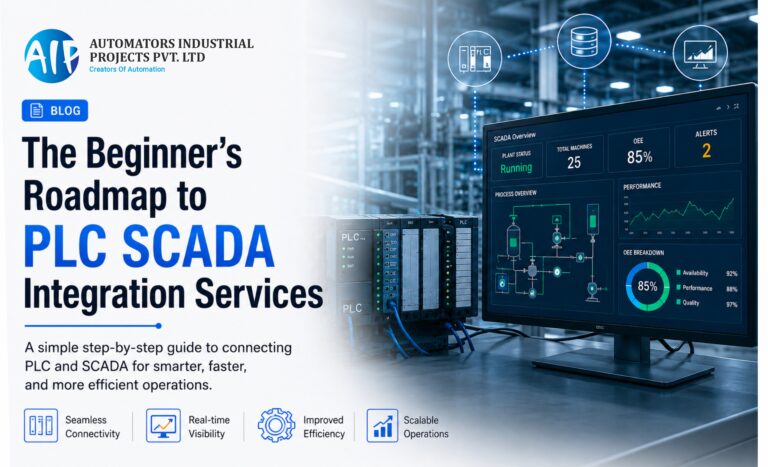
SCADA systems play a major role in modern industrial automation by helping industries monitor, control, and manage operations in real time. SCADA stands for Supervisory Control and Data Acquisition, and these systems are designed to collect live operational data from PLCs, sensors, industrial equipment, and connected machines across the production environment. The collected information is displayed through easy-to-understand dashboards, graphical interfaces, and control panels that provide operators with complete visibility into industrial processes. Instead of manually checking machines individually, operators can monitor the entire facility from a centralized control system.
SCADA systems are widely used to monitor machine performance, track production data, detect faults and alarms, analyze operational trends, manage energy usage, and remotely control industrial processes when required. This real-time monitoring capability helps industries quickly identify abnormal conditions, reduce downtime, improve maintenance planning, and maintain smoother production operations. SCADA systems also store historical production data, allowing businesses to analyze long-term performance trends and optimize workflows more effectively.
One of the biggest advantages of SCADA systems is improved operational visibility and faster decision-making. Operators can instantly receive alerts for equipment failures, temperature fluctuations, pressure changes, or production abnormalities, helping them respond before small issues become major operational problems. By providing accurate and real-time data insights, SCADA systems help industries improve productivity, reduce waste, enhance efficiency, and build smarter, more connected industrial operations.
4.How PLC and SCADA Work Together
PLC automation and SCADA systems complement each other perfectly.
Here’s how the process works:
- Sensors collect industrial data
- PLCs process the data and control machines
- SCADA systems receive information from PLCs
- Operators monitor operations through SCADA dashboards
- Commands can be sent back to PLCs for machine control
This creates a connected automation ecosystem where machines and operators stay synchronized.
For example:
If a production machine overheats, the PLC can automatically stop the machine, while the SCADA system immediately alerts operators and displays the fault condition.
This improves both safety and operational efficiency.
5.Why Industries Are Investing in PLC SCADA Integration Services
Industries today face increasing pressure to improve production speed, reduce downtime, and maintain consistent quality.
PLC SCADA integration services help solve these challenges by creating connected and intelligent production systems.
Key reasons industries are adopting PLC automation and SCADA systems include:
- Need for real-time production monitoring
- Reduction in manual errors
- Faster troubleshooting
- Better production efficiency
- Improved machine utilization
- Centralized operational control
As factories move toward smart manufacturing and Industry 4.0, integrated automation systems are becoming a necessity rather than a luxury.
6.Benefits of PLC Automation and SCADA Systems
Modern PLC automation and SCADA systems offer several operational advantages.
Improved Operational Efficiency
Automation reduces repetitive manual work and improves workflow consistency.
Reduced Downtime
SCADA systems provide instant fault alerts, helping maintenance teams respond quickly.
Better Production Quality
PLC automation ensures precise and repeatable machine operations.
Centralized Monitoring
SCADA systems allow operators to manage multiple machines from one location.
Real-Time Data Access
Industries gain valuable production insights that support better decision-making.
Scalability
Integrated systems can expand as production requirements grow.
These benefits make PLC SCADA integration services valuable for both small industries and large manufacturing facilities.
7.Real-Time Monitoring and Industrial Visibility
One of the biggest strengths of SCADA systems is real-time visibility.
Operators can monitor:
- Machine performance
- Production output
- Energy usage
- Temperature and pressure values
- Equipment health
- Alarm conditions
This level of visibility helps industries identify issues before they become major operational problems.
Real-time monitoring also supports predictive maintenance, helping businesses reduce unexpected machine failures.
8.Industries Using PLC SCADA Systems
PLC automation and SCADA systems are widely used across multiple industries.
Manufacturing Industry
- Production line automation
- Machine synchronization
- Automated material handling
Water Treatment Plants
- Pump control
- Flow monitoring
- Remote operations
Food and Beverage Industry
- Batch processing
- Packaging automation
- Quality monitoring
Pharmaceutical Industry
- Controlled process environments
- Compliance monitoring
- Production tracking
Oil and Gas Industry
- Pipeline monitoring
- Pressure control systems
- Safety automation
The flexibility of PLC SCADA integration services makes them suitable for almost every industrial sector.
9.Common Challenges in PLC SCADA Integration
While PLC SCADA integration services offer major benefits, implementation can sometimes be complex.
Common challenges include:
- Integrating legacy machines
- Communication compatibility issues
- Cybersecurity concerns
- Data management complexity
- Network configuration challenges
This is why industries often work with experienced automation solution providers to ensure smooth system integration.
10.How AIP Supports PLC SCADA Integration Services
AIP provides end-to-end PLC SCADA integration services designed around practical industrial requirements.
The company supports:
- PLC automation programming
- SCADA system development
- Industrial communication setup
- HMI development
- Real-time monitoring solutions
- Automation system upgrades
By focusing on scalable and efficient automation strategies, AIP helps businesses build connected industrial operations that improve productivity and operational visibility.
11.Future of PLC Automation and SCADA Systems
The future of industrial automation is becoming more connected and intelligent.
Modern PLC automation and SCADA systems are evolving with technologies such as:
- Industrial IoT
- Cloud-based monitoring
- AI-driven analytics
- Predictive maintenance
- Smart manufacturing systems
Future factories will rely heavily on data-driven automation where machines, software, and operators work together seamlessly
12.Getting Started with Industrial Automation
Businesses planning PLC SCADA integration should first evaluate:
- Current production challenges
- Existing machine infrastructure
- Automation goals
- Monitoring requirements
- Future scalability needs
A phased approach to PLC automation and SCADA system integration often delivers the best long-term results.
Final Thoughts
PLC SCADA integration services are helping industries move toward smarter, more efficient, and more connected operations.
By combining reliable PLC automation with advanced SCADA systems, businesses can improve productivity, reduce downtime, and gain real-time visibility into industrial processes.
For industries planning their automation journey, understanding PLC SCADA integration is one of the most important first steps toward building future-ready manufacturing environments.
FAQs
1. What are PLC SCADA integration services?
PLC SCADA integration services involve connecting machine control systems with centralized monitoring platforms to improve industrial automation and operational visibility.
2. What is PLC automation used for?
PLC automation is used for controlling industrial machines, production lines, motors, conveyors, and automated manufacturing processes.
3. Why are SCADA systems important?
SCADA systems provide real-time monitoring, data visualization, alarm management, and centralized operational control.
4. Which industries use PLC automation and SCADA systems?
Manufacturing, pharmaceuticals, food processing, water treatment, oil and gas, and power industries commonly use these systems.