
What Is PLC SCADA? A Complete Guide for Manufacturers in 2026
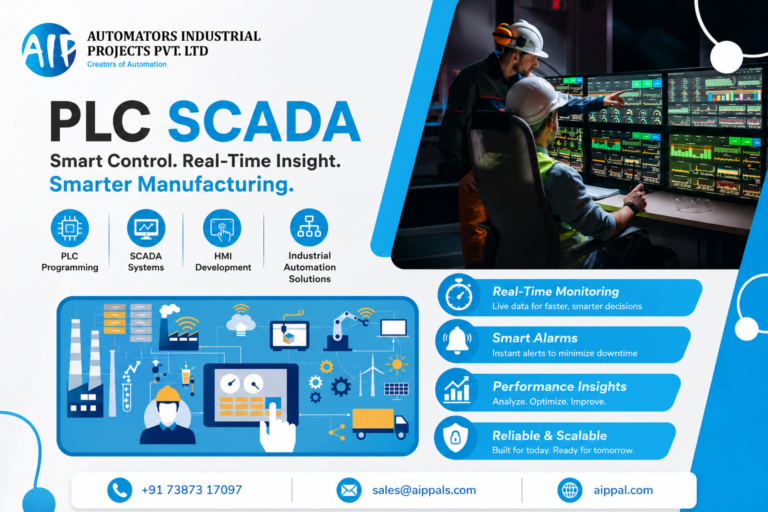
Industrial automation solutions provider
PLC SCADA | PLC Programming | SCADA System | HMI Development
In today’s rapidly evolving industrial landscape, manufacturers face increasing pressure to maximize productivity, reduce downtime, improve quality, and maintain operational efficiency. Traditional manual monitoring methods are no longer capable of meeting the demands of modern production environments where real-time decision-making is essential.
This is where PLC SCADA systems play a critical role.
PLC SCADA solutions form the backbone of industrial automation by combining machine-level control with plant-wide monitoring and data visualization. These systems help manufacturers monitor operations, control equipment, analyze performance, and make informed decisions based on real-time production data.
From automotive manufacturing and process industries to energy plants, warehouses, and special-purpose machinery, PLC SCADA systems are enabling smarter, safer, and more efficient industrial operations.
As an industrial automation solutions provider, AIP helps manufacturers implement advanced PLC SCADA systems that improve operational visibility, reduce downtime, and support long-term industrial growth.
Key Takeaways
✓ Understand what PLC SCADA is and how it works
✓ Learn the difference between PLC, SCADA, and HMI systems
✓ Discover how PLC programming controls industrial processes
✓ Explore the benefits of real-time production monitoring
✓ Understand why PLC SCADA is essential for Industry 4.0 manufacturing
Table of Contents
1.What Is PLC SCADA
PLC SCADA is an industrial automation solution that combines a Programmable Logic Controller (PLC) with a Supervisory Control and Data Acquisition (SCADA) system.
The PLC controls machines and industrial processes in real time, while the SCADA system collects data, visualizes operations, generates alarms, and provides centralized monitoring across the plant.
In simple terms, the PLC acts as the brain that controls equipment, while SCADA acts as the monitoring platform that gives operators and managers complete visibility into production operations.
Together, PLC SCADA systems provide reliable machine control, real-time monitoring, process optimization, and operational intelligence that modern manufacturing facilities require.
2.What Is a PLC and How Does It Work
A Programmable Logic Controller (PLC) is a rugged industrial computer designed to control machinery and industrial processes.
PLCs continuously receive signals from sensors and field devices, process those signals using programmed logic, and then control outputs such as motors, pumps, valves, conveyors, and robotic systems.
The PLC performs three primary functions:
Input Processing
The PLC receives signals from sensors, switches, and measurement devices.
Logic Execution
The controller executes programmed instructions using PLC programming languages such as Ladder Logic and Structured Text.
Output Control
Based on the logic, the PLC activates or deactivates motors, actuators, valves, and other equipment.
Because PLCs are designed for harsh industrial environments, they operate reliably under extreme temperatures, vibration, dust, and electrical noise.
Common PLC manufacturers include Siemens, Allen-Bradley, Beckhoff, Mitsubishi Electric, and WAGO.
3.What Is SCADA and How Does It Work
SCADA stands for Supervisory Control and Data Acquisition, a centralized industrial monitoring system that collects operational data from PLCs and industrial devices, displays information through graphical dashboards, stores historical production records, and allows operators to supervise manufacturing processes efficiently from a single location. Modern SCADA systems provide real-time monitoring of machine performance and production activities, generate alarms and alerts when faults or abnormalities occur, maintain historical data for reporting and analysis, support remote access for authorized personnel, and offer performance analytics that help industries identify operational trends and optimize manufacturing processes. By delivering complete operational visibility and real-time production intelligence, SCADA systems help manufacturers improve decision-making, reduce downtime, enhance productivity, and maintain smoother industrial operations.
4.PLC vs SCADA vs HMI
Many manufacturers confuse PLC, SCADA, and HMI systems. Although they work together, each serves a different purpose.
PLC
Controls industrial equipment and processes in real time.
HMI (Human Machine Interface)
Provides a local touchscreen interface for operators to interact with a machine.
SCADA
Provides centralized plant-wide monitoring, reporting, and supervisory control.
A simple way to understand the relationship is:
PLC = Control Layer
HMI = Operator Interface Layer
SCADA = Supervisory Layer
Together they create a complete industrial automation ecosystem capable of delivering reliable control and operational visibility.
5.Why PLC SCADA Matters for Manufacturers
Manufacturers can lose significant revenue when production systems experience unexpected downtime, equipment failures, or process inefficiencies. A properly designed PLC SCADA system helps industries overcome these challenges by providing real-time monitoring, automated control, and better visibility into manufacturing operations. These systems help reduce unplanned downtime, improve equipment reliability, increase production efficiency, enhance product quality, boost operator productivity, and lower overall maintenance costs.
By continuously monitoring machine performance and process conditions, PLC SCADA solutions enable maintenance teams to detect faults and abnormalities before they develop into costly breakdowns. The system also improves process visibility and supports data-driven decision-making by providing accurate operational insights and performance analytics. As manufacturing continues to embrace digital transformation and Industry 4.0 technologies, PLC SCADA systems have become essential tools for achieving operational excellence, improving competitiveness, and supporting long-term business growth.
6.Key Components of a PLC SCADA System
A complete PLC SCADA solution consists of several integrated components.
Field Devices
Sensors, transmitters, switches, and actuators that interact with physical processes.
PLC Controllers
Industrial computers that execute automation logic.
Communication Network
Industrial communication protocols and networking infrastructure connecting devices.
HMI Systems
Operator interfaces for machine-level control and monitoring.
SCADA Software
Centralized monitoring and data acquisition platform.
Data Historian
Stores historical production and operational data for reporting and analysis.
Together, these components create a connected automation environment capable of supporting modern manufacturing operations.
7.Benefits of PLC SCADA Solutions
PLC SCADA systems deliver numerous operational advantages.
Improved Operational Efficiency
Automation reduces manual intervention and improves consistency.
Reduced Downtime
Real-time alarms help maintenance teams respond quickly.
Better Product Quality
Automated monitoring ensures processes remain within specifications.
Increased Visibility
Managers gain complete insight into production operations.
Real-Time Decision Making
Accurate production data supports faster and smarter decisions.
Enhanced Safety
Automated monitoring reduces operational risks and improves workplace safety.
Scalability
Systems can grow alongside future production requirements.
These benefits help manufacturers improve productivity while reducing operational costs.
8.Industries Using PLC SCADA Systems
PLC SCADA technology is used across virtually every industrial sector.
Automotive Manufacturing
Assembly line automation, robotics integration, and quality monitoring.
Process Industries
Chemical processing, pharmaceuticals, food manufacturing, and batch production.
Water and Wastewater Treatment
Remote monitoring and process control.
Energy and Utilities
Power generation, distribution, and renewable energy systems.
Warehousing and Logistics
Automated material handling and warehouse management systems.
Special Purpose Machines
Custom industrial equipment requiring advanced automation control.
The flexibility of PLC SCADA systems makes them suitable for a wide range of industrial applications.
9.Choosing the Right PLC SCADA Partner
The success of a PLC SCADA project depends heavily on selecting the right automation partner. While advanced technologies and modern software platforms are important, the expertise of the implementation team plays a crucial role in determining project performance, commissioning speed, and long-term system reliability. Choosing an experienced partner helps ensure that automation solutions are designed correctly, integrated efficiently, and aligned with specific industry requirements.
Manufacturers should evaluate several key factors before selecting a PLC SCADA service provider. These include industry experience, plant commissioning expertise, PLC programming capabilities, SCADA development knowledge, HMI design and development skills, compliance with industry standards, and the availability of ongoing technical support. A strong project delivery track record is also important, as it demonstrates the partner’s ability to successfully execute automation projects across different industrial environments.
An experienced automation partner can significantly reduce commissioning time, minimize implementation risks, and improve overall system performance. Their expertise helps ensure smooth integration between hardware and software components while providing scalable solutions that support future expansion. By working with a trusted PLC SCADA specialist, manufacturers can achieve greater operational efficiency, improved reliability, and long-term success in their automation initiatives.
10.How AIP Supports PLC SCADA Projects
AIP provides comprehensive PLC SCADA solutions designed for modern manufacturing environments.
Services include:
- PLC Programming
- SCADA Development
- HMI Development
- Industrial Network Integration
- Plant Commissioning
- Automation System Design
- Production Monitoring Solutions
- MES Integration
- Smart Manufacturing Solutions
With experience across automotive, process automation, energy, warehouse automation, and industrial manufacturing sectors, AIP helps businesses implement scalable automation systems that support long-term growth.
11.Future of PLC SCADA Systems
Industrial automation continues to evolve rapidly as manufacturers adopt smarter and more connected technologies to improve efficiency, productivity, and decision-making. Future PLC SCADA systems will increasingly integrate with Industrial IoT (IIoT), Artificial Intelligence (AI), predictive maintenance platforms, cloud-based monitoring systems, digital twin technologies, advanced analytics platforms, and smart factory infrastructure. These integrations will enable manufacturing systems to collect, process, and analyze larger volumes of operational data in real time.
As these technologies mature, PLC SCADA solutions will provide greater visibility into production operations, enhanced predictive capabilities, and more intelligent process optimization. Manufacturers will be able to identify potential equipment failures before they occur, improve resource utilization, and make faster data-driven decisions. Despite the emergence of new digital technologies, PLC SCADA systems will remain a foundational element of Industry 4.0, serving as the core platform that connects machines, processes, operators, and business systems within future smart manufacturing environments.
12.Getting Started with PLC SCADA Implementation
Before implementing a PLC SCADA system, manufacturers should evaluate:
- Existing automation infrastructure
- Production challenges
- Monitoring requirements
- Control system architecture
- Data collection needs
- Future scalability goals
- Cybersecurity requirements
A structured implementation strategy helps maximize return on investment and ensures long-term operational success.
Working with experienced automation specialists can significantly simplify deployment and reduce project risks.
Final Thoughts
PLC SCADA systems are the foundation of modern industrial automation, providing real-time machine control, centralized monitoring, and operational intelligence.
By combining PLC programming, SCADA software, and HMI development, manufacturers can reduce downtime, improve quality, increase productivity, and gain complete visibility into production operations.
As industries continue their transition toward Industry 4.0 and smart manufacturing, PLC SCADA solutions will play an increasingly important role in building connected, efficient, and future-ready factories.
For businesses planning automation upgrades or new industrial projects, understanding PLC SCADA is an essential step toward achieving long-term operational excellence.
FAQs
1. What is PLC SCADA?
PLC SCADA is an industrial automation system that combines Programmable Logic Controllers (PLCs) for machine control with SCADA software for monitoring, data acquisition, and supervisory control.
2. What is the difference between PLC and SCADA?
A PLC controls industrial equipment in real time, while SCADA provides centralized monitoring, visualization, alarm management, and data collection
3. Is SCADA the same as HMI?
No. An HMI is a local operator interface for a specific machine, while SCADA provides plant-wide monitoring and supervisory control across multiple systems.
4. What programming languages are used in PLC programming?
Common PLC programming languages include Ladder Logic, Structured Text, Function Block Diagram (FBD), and Sequential Function Chart (SFC).