
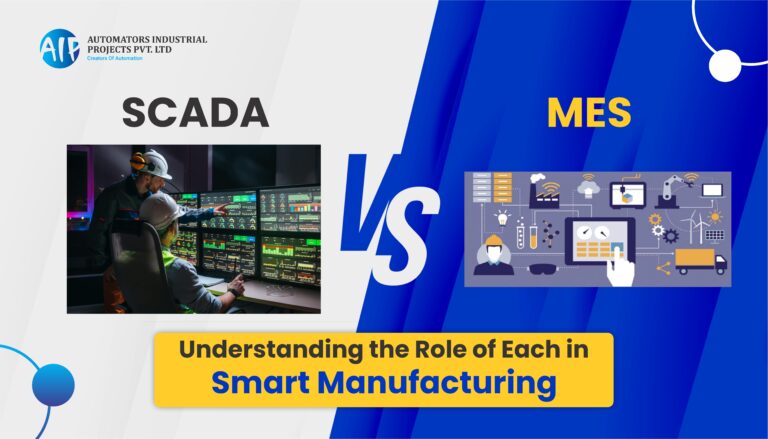
SCADA vs MES: Understanding the Role of Each in Smart Manufacturing
industrial automation solutions provider
industrial automation | smart manufacturing | SCADA systems | MES platforms
Modern factories run on data, and success depends on how effectively that data is used. Within industrial automation environments, machines communicate continuously, enabling faster decisions and more responsive operations. Yet many manufacturing teams still ask whether SCADA systems, MES platforms, or a combination of both is required to support smart manufacturing goals.
Understanding how SCADA systems provide real-time monitoring while MES platforms manage production execution is essential for building connected, efficient production environments. For manufacturers advancing their industrial automation strategy, the objective is not just monitoring machines but improving overall production performance through structured, data-driven operations.
As a trusted automation partner, AIP supports manufacturers in developing integrated smart manufacturing environments that combine real-time operational visibility with production intelligence powered by SCADA systems and MES platforms.
Key Takeaways
✓ Clear understanding of how monitoring and execution systems differ
✓ Better production visibility across operations
✓ Faster, data-driven decision-making
✓ Improved traceability and process control
✓ Stronger alignment between shop-floor operations and production goals
Table of Contents
1.Understanding the Smart Manufacturing Structure
Modern production environments follow a structured system hierarchy.
Machines and sensors collect data.
Controllers manage machine behavior.
Supervisory systems monitor operations.
Execution systems manage production flow.
Enterprise systems handle business planning.
Within this structure, SCADA systems monitor operations in real time, while MES platforms manage how production is executed.
Both are essential for effective industrial automation.
2.What SCADA Systems Actually Do
SCADA systems play a foundational role in modern industrial automation by providing real-time monitoring and control of machines, processes, and production environments. They connect directly to equipment and controllers to deliver instant visibility into what is happening across the shop floor. As a core technology supporting smart manufacturing, SCADA systems enable operators and engineers to respond quickly to operational changes, maintain process stability, and ensure consistent production performance.
In daily operations, SCADA systems help teams view machine status instantly, monitor alarms and events, track critical process parameters, control equipment when required, display live operational dashboards, and capture valuable production data. This continuous flow of real-time information supports faster decision-making, reduces operational uncertainty, and improves overall equipment reliability.
In simple terms, SCADA answers one essential question:
“What is happening right now?”
By delivering immediate operational awareness, SCADA systems ensure equipment runs as expected and production processes remain under control. However, while SCADA provides deep machine-level visibility, it focuses primarily on monitoring and control rather than production execution management. That is why many smart manufacturing environments complement SCADA with MES platforms to connect real-time machine data with structured production intelligence across the plant.
3.What MES Platforms Actually Do
MES platforms operate at a broader production management level within modern industrial automation environments. Rather than only monitoring machines like SCADA systems, MES platforms manage and optimize how production is executed across the entire plant. They transform raw shop-floor data into structured, actionable information that supports smart manufacturing objectives such as efficiency, traceability, and performance improvement.
In practical terms, MES platforms help organizations coordinate production by tracking work orders in real time, managing production scheduling, recording quality data, enabling full product traceability, monitoring production efficiency, and maintaining complete production history. By connecting machine-level data with operational workflows, MES platforms ensure that every stage of manufacturing is visible, measurable, and controllable.
MES answers a critical operational question:
“How well is production performing?”
By linking real-time equipment data from SCADA systems with structured production intelligence, MES platforms provide manufacturers with deeper insight into performance trends, process stability, and operational efficiency. This integration enables data-driven decision-making, improves production planning accuracy, strengthens compliance readiness, and supports continuous improvement initiatives essential for scalable smart manufacturing systems
4.The Real Difference Between SCADA and MES
SCADA Systems | MES Platforms |
Focus on monitoring operations in real time | Focus on managing and optimizing production execution |
Show machine and process activity | Explain production performance and outcomes |
Provide instant operational visibility | Provide structured production intelligence |
Tell you what is happening on the shop floor | Help you understand results, efficiency, and trends |
Support real-time control and monitoring | Support production planning, tracking, and analysis |
Enable operational awareness | Enable performance optimization |
5.The Common Gap in Many Factories
Many manufacturing facilities rely heavily on monitoring tools but lack structured production management systems.
This often leads to:
Manual reporting processes.
Delayed performance insights
Limited production traceability
Difficulty identifying downtime causes
Fragmented operational data
When production data is not organized and analyzed, valuable information remains unused.
6.Why Monitoring Alone Is Not Enough
Real-time visibility is important, but visibility alone does not improve production performance.
Monitoring systems typically do not:
• Track product history
• Connect production to planning
• Provide structured performance analysis
• Support long-term optimization
As manufacturing becomes more complex, organizations need systems that not only observe operations but also guide execution.
7.The Value of Combining SCADA and MES
When SCADA systems and MES platforms work together, production data becomes meaningful and actionable.
The integration allows:
• Production orders to be tracked accurately
• Quality information to be connected to operations
• Performance insights to be generated automatically
This combination helps teams move from reactive responses to proactive control.
8.Implementation and Integration Challenges
Despite clear benefits, many organizations hesitate to implement MES due to practical concerns.
Common challenges include:
Without structured architecture, connecting monitoring and execution systems can be difficult.
• Long deployment timelines
• Engineering resource requirements
• Risk of disrupting production
9.How AIP Supports System Alignment
AIP helps manufacturers design connected production environments that align monitoring and execution systems within a unified industrial automation architecture.
The approach focuses on:
• Scalable deployment strategies
• Clean data flow across systems
• Simplified integration frameworks
This ensures monitoring and execution capabilities evolve together rather than separately
10.Business Impact of Proper System Integration
When monitoring and execution systems operate in alignment, organizations gain measurable operational improvements.
These include:
• Clear visibility into downtime causes
• Stronger production traceability
• Faster decision-making
• Improved production predictability
For manufacturers pursuing smart manufacturing, these outcomes directly support operational competitiveness.
11.Industry Use Cases
Automotive Manufacturing
• Production line monitoring
• Component tracking
• Performance visibility
Pharmaceutical Production
• Batch tracking
• Compliance-ready records
• Process visibility
Food and Packaging
• Production monitoring
• Quality tracking
• Recall traceability
OEM and Machinery Builders
• Standardized system design
• Faster deployment
• Scalable production frameworks
Across industries, the objective remains consistent: use data to improve production performance.
12.Building a Future-Ready Factory
Organizations planning future automation strategy should evaluate:
• Whether production performance is measurable in real time
• Whether systems can scale across facilities
• Whether automation supports business goals
Future-ready industrial automation environments are connected, scalable, and data-driven.
Final Thoughts
SCADA systems and MES platforms are not alternatives. They are partners within modern production environments.
SCADA provides real-time operational visibility.
MES provides structured production intelligence.
Together, they support smarter decisions, better performance, and scalable growth.
For manufacturers pursuing smart manufacturing, success depends not on individual systems — but on how well systems work together.
FAQs
1.What is the main difference between SCADA systems and MES platforms?
2.Do manufacturers need both systems?
Yes. Monitoring and execution management serve different purposes and together provide complete production visibility.
3.How do these systems support smart manufacturing?
They connect real-time operations with structured production management, enabling data-driven decisions and improved performance.
4.How does industrial automation support modern manufacturing growth?
Industrial automation connects machines, systems, and data to improve efficiency, visibility, and production consistency.