
Pick and Place Automation for CNC Machines: 7 Benefits Every Manufacturing Manager Should Know
Industrial automation solutions provider
Pick and Place Automation for CNC Machines | Pick and Place Systems | CNC Automation | Robotic Material Handling
In today’s competitive manufacturing environment, CNC machine shops are constantly looking for ways to increase productivity, reduce labor dependency, and improve production consistency. As industries move toward smart manufacturing and Industry 4.0, pick and place automation has become a key technology for modern CNC operations.
Many manufacturers still rely on manual loading and unloading of CNC machines. While this approach may work for low-volume production, it often leads to longer cycle times, operator fatigue, inconsistent quality, and increased production costs.
This guide explains the 7 major benefits of pick and place automation for CNC machines and how automated material handling systems can transform manufacturing efficiency, productivity, and profitability.
Key Takeaways
✓ Understand what CNC pick and place automation is
✓ Learn how robotic systems improve CNC machine utilization
✓ Discover how automation reduces labor costs and errors
✓ Explore the impact on productivity and quality
✓ Understand the role of automation in Industry 4.0 manufacturing
Table of Contents
1.What is Pick and Place Automation for CNC Machines?
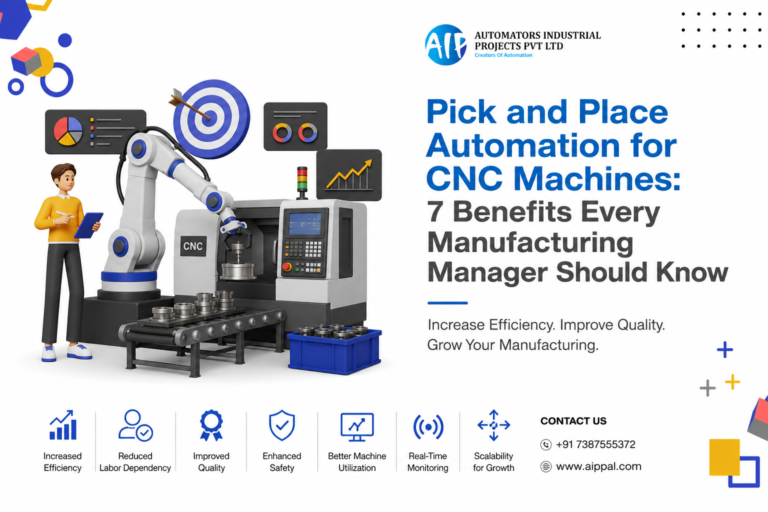
Pick and place automation refers to the use of robotic systems, pneumatic manipulators, gantry robots, or robotic arms to automatically load raw materials into CNC machines and unload finished parts after machining.
Instead of relying on manual operators, the automation system handles repetitive material transfer tasks with high speed and precision.
A typical CNC pick and place system consists of:
- Industrial Robot or Robotic Arm
- PLC Control System
- Sensors and Safety Devices
- Conveyor System
- CNC Machine Interface
- HMI or SCADA Monitoring System
A simple workflow is:
Raw Material → Robot Pick → CNC Machine Loading → Machining → Part Unloading → Finished Product
2.Increased Production Efficiency
Manufacturing industries continuously seek methods to improve productivity and maximize the efficiency of CNC machines. One of the most effective ways to achieve this is through pick and place automation. In conventional CNC operations, operators manually load raw materials and unload finished components, which consumes valuable production time and often results in machine idle periods. Automated pick and place systems eliminate these delays by handling material transfer quickly and accurately. As a result, loading times are significantly reduced, machining cycles become more streamlined, and production flow remains uninterrupted throughout the manufacturing process.
By minimizing human intervention in repetitive loading and unloading tasks, automated systems ensure that CNC machines spend more time machining and less time waiting for materials. Continuous operation leads to better machine utilization, higher throughput, and improved overall efficiency. Manufacturers can produce a greater number of components within the same production period without investing in additional CNC machines. This increased productivity not only reduces operational costs but also helps businesses meet growing customer demands while maintaining consistent production quality.
3.Reduced Labor Dependency
Many industries face challenges related to labor shortages, skill gaps, and increasing labor costs.
Automated pick and place systems reduce the need for operators to perform repetitive material handling tasks.
Benefits include:
- Lower labor costs
- Reduced dependency on skilled operators
- Improved workforce utilization
- Consistent production across shifts
Employees can focus on quality inspection, maintenance, and process optimization rather than repetitive loading activities.
4.Improved Product Quality and Consistency
Human handling can introduce variations in part positioning, loading accuracy, and process timing.
Robotic automation ensures:
- Precise part placement
- Repeatable positioning
- Consistent loading sequences
- Reduced handling damage
This improves machining accuracy and helps maintain uniform product quality throughout the production process.
For industries such as automotive, aerospace, and medical manufacturing, consistency is critical for meeting strict quality standards.
5.Enhanced Workplace Safety
Manual material handling around CNC machines can expose operators to several workplace hazards. During loading and unloading operations, workers may come into close contact with moving machine parts, sharp metal edges, hot machined components, and heavy raw materials. These risks increase the likelihood of injuries, accidents, and operator fatigue, especially in high-volume production environments where repetitive tasks are performed continuously throughout the day.
Pick and place automation significantly improves workplace safety by reducing the need for direct human interaction with CNC machines. Robotic systems automatically transfer materials between workstations, allowing operators to remain at a safe distance from potentially dangerous machine zones. By minimizing manual handling activities, manufacturers can reduce workplace injuries, lower accident rates, and create a safer and more efficient production environment.
Modern automated systems are also equipped with advanced safety features to ensure reliable and secure operation. Technologies such as safety light curtains, emergency stop circuits, interlocking mechanisms, and safety PLCs continuously monitor the work area and respond immediately to unsafe conditions. These protective measures help organizations comply with industrial safety standards while enhancing overall operational reliability and employee well-being.
6.Better Machine Utilization
A CNC machine generates revenue only when it is actively machining parts.
When operators are unavailable or busy with other tasks, machines remain idle.
Automation helps maximize machine utilization by:
- Maintaining continuous loading and unloading
- Supporting unattended operation
- Enabling lights-out manufacturing
- Reducing setup delays
Higher utilization directly translates into increased production capacity and faster return on investment.
7.Real-Time Monitoring and Smart Manufacturing
Modern CNC automation systems can seamlessly integrate with industrial technologies such as PLCs, HMIs, SCADA systems, MES platforms, and ERP software. This connectivity enables smooth communication between machines, operators, and management systems across the manufacturing facility.
PLCs act as the control layer of the automation system by managing machine operations and processing real-time inputs and outputs. They ensure accurate execution of machining processes while maintaining synchronization with connected automation equipment.
HMIs provide operators with an intuitive interface to monitor machine conditions, view process parameters, and make operational adjustments when required. This improves operator efficiency and enhances overall control of the manufacturing process.
SCADA systems collect data from multiple machines and production lines, providing centralized monitoring and supervision. They allow manufacturers to track machine status, monitor alarms, and visualize production performance through real-time dashboards.
MES (Manufacturing Execution Systems) bridge the gap between shop-floor operations and business management. They help manage production schedules, track work orders, monitor resource utilization, and improve manufacturing efficiency.
ERP systems integrate production data with business functions such as inventory management, procurement, finance, and supply chain operations. This creates a unified information flow that supports better planning and decision-making across the organization.
Through this integrated automation ecosystem, manufacturers gain access to real-time production monitoring, detailed reporting, OEE analysis, alarm management, and predictive maintenance insights. Complete visibility into production performance enables data-driven decisions that improve productivity, reduce downtime, and support continuous operational improvement.
8.Scalability for Future Growth
As production demand increases, automation systems can be expanded to support additional machines and processes.
- Scalable solutions include:
- Multi-machine robotic cells
- Automated pallet systems
- Conveyor integration
- Vision-guided robotics
- Flexible manufacturing systems (FMS)
This allows manufacturers to grow production capacity without proportionally increasing labor requirements.
9.Why CNC Automation Matters
In today’s highly competitive manufacturing industry, companies that continue to rely solely on manual operations often face several challenges, including higher operating costs, production bottlenecks, labor shortages, quality inconsistencies, and reduced market competitiveness. Pick and place automation provides an effective solution to these issues by streamlining material handling processes, improving production efficiency, and ensuring consistent product quality. By reducing dependence on manual labor and maximizing machine utilization, manufacturers can increase productivity while lowering operational expenses. As industries continue to adopt smart manufacturing practices, automation is no longer viewed as a luxury but as a strategic investment that supports long-term growth, operational excellence, and sustainable business success.
10.Applications of CNC Pick and Place Automation
Pick and place automation is widely used across multiple industries:
Automotive Industry
- Engine components
- Transmission part
- Brake components
Aerospace Industry
- Precision machined components
- Structural assemblies
Medical Manufacturing
- Surgical instruments
- Implant components
Electronics Industry
- Precision metal housings
- Connector components
General Manufacturing
- Shafts
- Bushings
- Gears
- Valves
- Custom machined parts
These applications benefit from high-speed, accurate, and reliable material handling.
Final Thoughts
Pick and place automation is revolutionizing CNC manufacturing by enhancing productivity, improving product quality, and increasing overall operational efficiency. Automated material handling ensures faster and more reliable production processes with minimal human intervention.
By automating loading and unloading operations, manufacturers can maximize machine utilization, reduce labor costs, and maintain consistent product quality. These improvements help businesses achieve higher output while minimizing operational expenses.
Automation also enhances workplace safety and supports Industry 4.0 initiatives through smarter, data-driven manufacturing. As production requirements continue to grow, CNC pick and place automation provides a scalable foundation for future-ready manufacturing operations.
FAQs
1. What is a CNC pick and place system?
A CNC pick and place system uses robots or automated handling equipment to load raw materials into CNC machines and unload finished components automatically.
2. Can one robot serve multiple CNC machines?
Yes. Modern robotic cells can be designed to load and unload multiple CNC machines, improving utilization and reducing equipment costs.
3. What types of robots are used in CNC automation?
Common options include articulated robots, SCARA robots, collaborative robots (cobots), gantry systems, and Cartesian robots.
4. Is CNC pick and place automation suitable for small manufacturers?
Yes. Compact robotic systems and cobots make automation affordable and practical even for small and medium-sized manufacturing facilities.