
PLC vs SCADA vs HMI: 7 Key Differences Every Plant Manager Should Know
Industrial automation solutions provider
PLC vs SCADA vs HMI | PLC Programming | SCADA System | HMI Development
In today’s rapidly evolving manufacturing environment, plant managers are under constant pressure to improve productivity, reduce downtime, and increase operational visibility. As factories embrace digital transformation and Industry 4.0 initiatives, technologies such as PLCs, SCADA systems, and HMIs have become essential components of industrial automation.
However, many manufacturers still confuse these technologies or assume they perform the same function. Misunderstanding the difference between PLC, SCADA, and HMI can lead to poor automation decisions, unnecessary costs, and limited operational visibility.
This guide explains the 7 key differences between PLC, SCADA, and HMI, helping plant managers understand where each technology fits within an automation architecture and how they work together to create efficient, scalable manufacturing systems.
As the engineering team at Automators Industrial Projects (AIP), we have commissioned more than 50 industrial plants and contributed to automotive standards such as INTEGRA for Mercedes-Benz and TMO for BMW.
Key Takeaways
✓ Understand the difference between PLC, SCADA, and HMI systems
✓ Learn how each technology fits into the automation pyramid
✓ Discover which system controls machines and which provides visibility
✓ Explore differences in scope, users, and data handling
✓ Learn how to choose the right automation architecture for your plant
Table of Contents
1.PLC vs SCADA vs HMI: The Short Answer
Before exploring the detailed differences, it helps to understand the fundamental role of each technology.
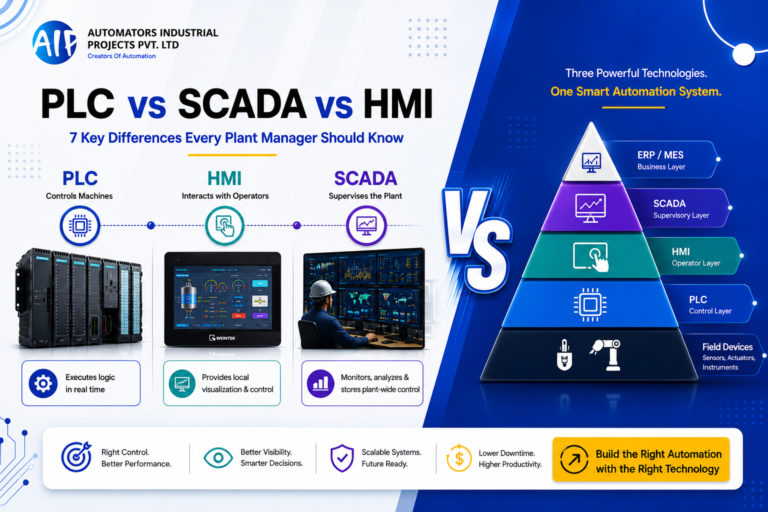
A Programmable Logic Controller (PLC) controls machines and industrial processes in real time. An HMI (Human Machine Interface) allows operators to interact with equipment through screens and controls. A SCADA (Supervisory Control and Data Acquisition) system provides centralized monitoring, data collection, alarm management, and plant-wide supervision.
A simple way to remember:
PLC = Control Layer
HMI = Operator Interface Layer
SCADA = Supervisory Layer
These technologies are not competitors. They are complementary layers of a complete industrial automation system.
2.Core Function: Control vs Interaction vs Supervision
The most important difference between PLC, SCADA, and HMI is their primary function.
PLC
PLCs continuously read sensor inputs, execute control logic, and activate outputs such as motors, pumps, valves, conveyors, and robots.
HMI
HMIs provide machine operators with a graphical interface to monitor machine status, adjust settings, and issue commands.
SCADA
SCADA systems collect information from multiple PLCs, display plant-wide dashboards, manage alarms, and store historical data for analysis.
In simple terms:
- PLCs control
- HMIs interact
- SCADA supervises
Understanding these distinct roles helps avoid costly automation design mistakes.
3.Position in the Automation Pyramid
Industrial automation systems are typically structured using the automation pyramid.
At the lowest level are sensors, actuators, and field devices. Directly above them sit PLCs, which execute control logic.
HMIs operate at the machine level, providing local access to equipment.
SCADA systems sit above PLCs and HMIs, collecting information from across the facility and providing centralized supervision.
The hierarchy typically follows:
Field Devices → PLC → HMI → SCADA → MES → ERP
This layered architecture enables efficient communication from the shop floor to business management systems.
4.Hardware vs Software
Another important distinction is whether the technology is primarily hardware or software.
PLC
A PLC is a rugged industrial controller designed to operate reliably in harsh environments including vibration, dust, electrical noise, and extreme temperatures.
HMI
An HMI combines hardware and software. It is usually a touchscreen panel installed near equipment.
SCADA
SCADA is primarily software running on servers, industrial computers, or cloud platforms.
Because of these differences:
- PLCs require hardware maintenance and replacement planning.
- HMIs require both hardware and interface updates.
- SCADA requires software licensing, cybersecurity management, and server infrastructure.
5.Scope: Single Machine vs Whole Plant
Many automation projects struggle because the required scope is not clearly defined at the planning stage. An HMI is typically designed to serve a single machine or production cell, providing operators with local control and real-time visibility. A PLC controls one machine or a closely integrated group of machines by executing automation logic and managing process operations in real time.
SCADA operates on a much larger scale, monitoring entire factories, multiple production lines, or even geographically distributed facilities from a centralized platform. If the requirement is simply local machine control, an HMI may be sufficient. However, when plant-wide visibility, centralized monitoring, historical data, and performance analysis are needed, a SCADA system becomes essential. The broader the monitoring and reporting requirements, the more valuable SCADA becomes.
6.Data Handling, Alarms, and History
PLCs, HMIs, and SCADA systems differ significantly in how they handle industrial data. PLCs are designed primarily for real-time control and decision-making. They continuously process inputs from sensors and execute control logic within milliseconds, but they typically store only limited historical data because their main focus is machine operation rather than long-term analysis.
HMIs provide operators with a visual interface to monitor machine performance, view process values, and respond to alarms. While HMIs can display live operational data and recent alarm history, they generally maintain only short-term records and are not intended for extensive data storage or plant-wide analysis.
SCADA systems are specifically built for advanced data management and operational intelligence. They collect and store historical production data, manage alarms across multiple machines, generate reports, provide trend analysis, support production analytics, and monitor overall plant performance. Manufacturers looking to implement OEE reporting, downtime analysis, predictive maintenance, or data-driven decision-making typically depend on SCADA systems rather than standalone PLCs or HMIs.
7.Who Uses Each System
Different users interact with different layers of the automation system.
Machine Operators
Operators primarily use HMIs to start, stop, monitor, and adjust equipment.
Automation Engineers
Control engineers design, program, troubleshoot, and maintain PLC logic.
Plant Managers and Supervisors
Managers use SCADA dashboards to monitor plant performance, production metrics, alarms, and downtime.
Each technology is optimized for a different audience, making proper interface design critical for operational success.
8.Cost, Scalability, and Growth
Cost structures vary significantly between PLCs, HMIs, and SCADA systems.
PLCs and HMIs typically scale on a per-machine basis.
As more production lines are added, additional controllers and operator panels are required.
SCADA systems generally involve higher upfront software and infrastructure investment but provide plant-wide visibility and scalability.
The long-term return on investment comes from:
- Reduced downtime
- Faster troubleshooting
- Improved production efficiency
- Better operational decision-making
- Enhanced maintenance planning
For growing manufacturers, SCADA often delivers the greatest strategic value despite higher initial costs.
9.Why Understanding the Difference Matters
One of the most common automation mistakes is assuming that a powerful HMI can replace a SCADA system or that a PLC alone can provide plant-wide visibility.
In reality, each technology serves a unique purpose.
Plants that invest only in PLCs and HMIs often struggle with:
- Limited production visibility
- Lack of historical data
- Poor downtime analysis
- Inefficient reporting
A properly designed architecture ensures that PLCs control processes, HMIs support operators, and SCADA provides the operational intelligence needed for continuous improvement.
10.How AIP Supports Automation Projects
AIP provides complete industrial automation solutions including:
- PLC Programming
- SCADA Development
- HMI Development
- Industrial Network Integration
- Plant Commissioning
- Production Monitoring Systems
- MES Integration
- Industry 4.0 Solutions
- Smart Manufacturing Platform
Our engineering team has delivered automation projects across automotive, process industries, warehouse automation, energy systems, and special-purpose machinery applications.
By combining control expertise with advanced monitoring solutions, we help manufacturers build scalable and future-ready automation environments.
Final Thoughts
PLC, SCADA, and HMI technologies are fundamental building blocks of modern industrial automation.
While they work together, they serve very different purposes.
PLCs provide real-time machine control.
HMIs provide operator interaction.
SCADA provides centralized monitoring, historical data, reporting, and operational intelligence.
Understanding these seven key differences enables plant managers to design automation systems more effectively, avoid unnecessary costs, and build a strong foundation for Industry 4.0 initiatives.
For manufacturers planning automation upgrades or new industrial projects, selecting the right combination of PLC, SCADA, and HMI technologies is essential for achieving long-term operational success.
FAQs
1. Is an HMI part of SCADA?
An HMI can be integrated into a SCADA system, but a standalone HMI is not SCADA. SCADA provides plant-wide monitoring, alarm management, and historical data collection across multiple systems.
2. Can a PLC operate without SCADA or HMI?
Yes. A PLC can independently control machinery using its programmed logic. SCADA and HMI systems provide visibility and user interaction but are not required for basic machine control.
3. Do I need both SCADA and HMI?
In most industrial environments, yes. HMIs provide local machine operation, while SCADA provides centralized monitoring and reporting across the plant.
4. Which comes first in automation system design?
Automation design typically begins with field devices and PLC control logic, followed by HMI development and SCADA implementation for supervisory monitorin