
How to Integrate Machine Vision with Existing PLC Systems to Reduce Defects by 40%
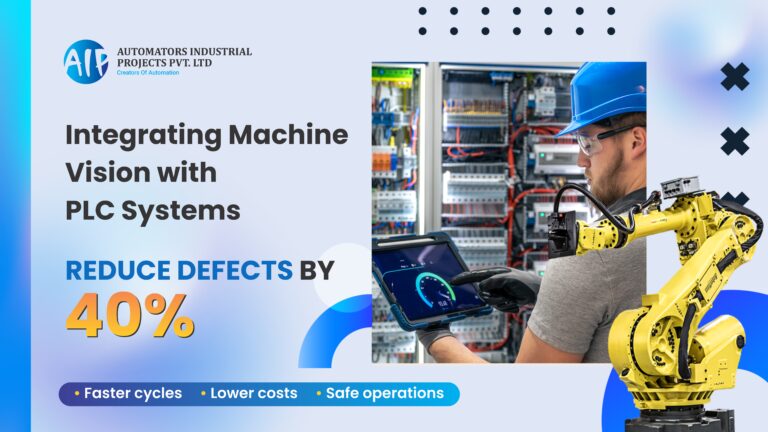
Manufacturing today is moving at an unprecedented pace. Customers now demand perfect quality, faster delivery timelines, and zero tolerance for errors. In this high-pressure environment, relying on manual inspection or traditional automation systems is no longer enough. These methods often struggle to keep up with modern production speeds, allowing defects to slip through unnoticed or be identified only after significant value has already been lost.
The good news is that manufacturers don’t need to rip and replace their entire automation infrastructure to solve this problem. By integrating Machine Vision with existing PLC systems, defects can be detected in real time, directly on the production line. This allows the system to take instant corrective action—such as rejecting faulty parts, stopping the line, or triggering alerts—before defects move further downstream.
When Machine Vision is combined with robotics and intelligent automation, the results are even more powerful. Manufacturers can achieve consistent quality, improved process control, and defect reduction of up to 40%, all while maintaining high throughput. This is exactly why industries across sectors—especially in major manufacturing hubs like vision integration in Pune and robotics solutions in Pune—are rapidly adopting vision-based automation to stay competitive, compliant, and future-ready.
Key Takeaways
- Machine Vision helps machines “see” defects automatically
- PLCs help machines “act” on those defects
- You can upgrade existing PLC systems—no need to start from scratch
- Vision and robotics improve quality, speed, and consistency
- Many factories in Pune are already using this technology successfully
Table of Contents
1.What is Machine Vision?
Machine Vision is an advanced inspection technology that enables machines to see, analyze, and make decisions using industrial-grade cameras and intelligent software. Similar to the human eye and brain working together, these systems capture high-resolution images of products and process them instantly to determine whether each part meets predefined quality standards—or should be rejected.
A typical Machine Vision setup includes high-resolution industrial cameras, carefully designed lighting systems to highlight critical features or defects, and powerful vision software that performs real-time image analysis. This vision system is seamlessly integrated with existing PLCs, robots, or motion controllers, allowing inspection results to directly trigger actions such as sorting, rejection, alarms, or line stoppage.
Unlike human inspectors, Machine Vision systems never get tired, distracted, or inconsistent. They deliver the same level of accuracy across every shift, at high speeds, and in harsh industrial environments. This makes Machine Vision the gold standard for high-speed, high-reliability inspection, especially in modern automated manufacturing lines where consistency and precision are non-negotiable.
2. Why PLC Integration Matters
While Machine Vision systems are responsible for detecting defects, it is the PLC (Programmable Logic Controller) that executes the corrective action. The PLC serves as the true brain of the factory floor, coordinating and controlling conveyors, reject mechanisms, robotic arms, safety interlocks, and alarm systems in real time.
When Machine Vision and PLCs are tightly integrated, the process becomes fully automated and intelligent. The vision system inspects each product and identifies any flaw—such as dimensional errors, surface defects, misalignment, or missing components. This inspection result is instantly communicated to the PLC, which then takes decisive action: automatically rejecting the faulty part, stopping the machine to prevent further waste, or signaling a robot to reposition, rework, or sort the product.
Without PLC communication, a vision system is limited to identifying problems. With proper PLC integration, it actively solves them in real time—reducing scrap, minimizing downtime, and ensuring consistent quality across the entire production line.
3. What Types of Defects Can Machine Vision Detect?
Machine Vision can easily detect:
- Missing parts
- Wrong or damaged components
- Scratches, cracks, or dents
- Wrong labels or barcodes
- Color mismatches
- Incorrect sizes or shapes
- Assembly mistakes
The moment a defect is detected, the PLC can remove the product or stop the proces
4. Common Challenges in Integration
Some factories worry about integration because of:
- Old PLC systems
- Different communication standards
- Too much data from cameras
- Lack of trained staff
The reality is:
Most modern vision systems are designed to work with existing PLCs. With the right integration partner, these challenges are easy to handle.
5. How Machine Vision and PLCs Work Together
The entire workflow operates as a seamless, closed-loop process that takes place within milliseconds. As each product moves along the production line, an industrial camera captures a precise image at the exact moment of inspection. This image is instantly processed by the vision software, which analyzes it against predefined rules, tolerances, and quality parameters to generate a clear “Pass” or “Fail” decision.
The inspection result is then transmitted in real time to the PLC. Based on this data, the PLC executes the required physical action—such as activating a pneumatic pusher to reject a defective part, diverting the product to a rework lane, or allowing conforming items to continue down the line. This rapid, automated feedback loop ensures consistent quality control without slowing production or relying on manual intervention.
6. How Vision Systems Communicate with PLCs
Communication between the Machine Vision system and the PLC is handled using standard industrial communication protocols, ensuring fast, reliable, and deterministic data exchange. In simpler applications, basic digital I/O signals (ON/OFF) may be sufficient to indicate pass/fail status or trigger a single action.
However, most modern automation projects—especially advanced Machine Vision integrations in Pune—rely on high-speed, Ethernet-based industrial protocols such as EtherNet/IP, PROFINET, and Modbus TCP/IP. These communication methods enable the transfer of detailed inspection data rather than just binary results. Information such as defect type, measurement values, part IDs, and inspection statistics can be shared directly with the PLC or higher-level systems.
This richer data exchange allows for more complex decision-making, improved traceability, and advanced diagnostics. As a result, manufacturers gain deeper insights into process performance, faster troubleshooting, and greater overall control of quality—making vision-PLC integration not just reactive, but truly intelligent.
7. Benefits of Machine Vision + PLC Integration
Factories that use vision and PLC integration see clear benefits:
- Up to 40% defect reduction
- Better and more consistent quality
- Faster production lines
- Less manual inspection
- Lower rejection and rework costs
- Improved machine efficiency
- Easy expansion with robots
This is why vision and robotics are becoming essential in modern factories.
8. Industry Use Cases
- Automotive: Part presence checks, weld inspection, and robot guidance for assembly.
- Food & Beverage:Packaging integrity, label verification, and expiry date checks.
- Electronics:High-precision PCB inspection and component alignment.
- Pharmaceuticals:Blister pack inspection and barcode serialization for safety.
- FMCG:Monitoring fill levels, cap placement, and seal quality.
9. Growing Demand for Vision and Robotics in Pune
Pune has rapidly emerged as one of India’s most prominent hubs for industrial automation and advanced manufacturing. With a strong presence of automotive OEMs, Tier-1 and Tier-2 suppliers, precision engineering firms, and large-scale manufacturing units, companies in the region are increasingly investing in vision-guided robots and smart inspection systems to stay competitive.
This accelerated adoption is driven by the shift toward Industry 4.0, where data-driven decision-making, real-time quality monitoring, and intelligent automation are becoming standard requirements. As a result, manufacturers across Pune are deploying Machine Vision integrated with robotics and PLC systems to automate quality control, reduce human dependency, and maintain consistent production standards.
These advancements have positioned robotics in Pune as one of the fastest-growing sectors in the region. Factories are no longer automating only for speed—they are automating for precision, traceability, and zero-defect manufacturing, making vision-based automation a critical pillar of modern industrial operations.
10. Future of Vision-Based Automation
The next evolution of Machine Vision and PLC integration is being driven by AI-based defect detection and predictive quality analytics. Instead of relying solely on fixed rules, future vision systems will learn from historical data, adapt to new defect patterns, and continuously improve inspection accuracy over time.
These advanced systems will go beyond simply rejecting defective parts. By analyzing inspection trends, process variations, and machine behavior, they will be able to predict potential failures before they occur—allowing maintenance teams to intervene proactively rather than reactively. This shift from detection to prediction will significantly reduce unplanned downtime, scrap, and maintenance costs.
As this technology matures, we are moving toward fully self-correcting production lines, where Machine Vision, PLCs, robotics, and AI operate as a single, intelligent ecosystem. In this environment, production systems won’t just respond to problems—they will anticipate, adapt, and optimize themselves, setting a new standard for efficiency, quality, and reliability in modern manufacturin
Final Thoughts
Integrating Machine Vision with your existing PLC is one of the smartest upgrades you can make. You don’t need to replace your machines; you just need to make them smarter. By adding “eyes” to your existing “brains,” you can reduce waste and stay ahead of the competition.
Want to reduce defects and improve quality? Explore our Vision & Robotics Automation Solutions and see how AIP can help you upgrade your production lines with smart, reliable automation.
FAQs
What is Machine Vision in simple words?
Machine Vision is a technology that combines industrial cameras and intelligent software to automatically inspect products for defects, deviations, or missing features. It can detect problems in real time, reduce human error, and ensure consistent quality across the production line.
Can Machine Vision work with old PLCs?
Yes. Most modern Machine Vision systems are designed to be highly compatible with existing PLCs, whether they are legacy models or newer ones. With proper integration, the vision system can send pass/fail signals, measurement data, or control commands directly to your existing controllers, allowing you to upgrade your quality inspection capabilities without replacing your entire automation setup.
Is Machine Vision expensive?
Not necessarily. While initial investment depends on the system’s complexity, Machine Vision often pays for itself quickly by reducing scrap, minimizing rework, improving yield, and enhancing overall production efficiency. Many manufacturers experience a strong return on investment (ROI) within months, especially in high-volume production lines
Is this suitable for small factories?
Absolutely. Machine Vision systems are highly scalable, meaning they can be customized for small, medium, or large operations. Small factories can start with a single inspection point or a compact system and gradually expand as production requirements grow, allowing them to compete with larger manufacturers in terms of quality control.
Why is Pune strong in vision and robotics?
Pune has become a major hub for industrial automation thanks to its thriving manufacturing base, skilled engineers, and strong focus on Industry 4.0 solutions. Local companies are rapidly adopting vision-guided robots and smart inspection systems to improve efficiency, reduce errors, and stay competitive. This combination of talent, infrastructure, and forward-thinking industries has made Pune a leading center for robotics and vision-based automation in India.