
5 Ways Machine Vision Is Improving OEE in Indian Food & Beverage Plants
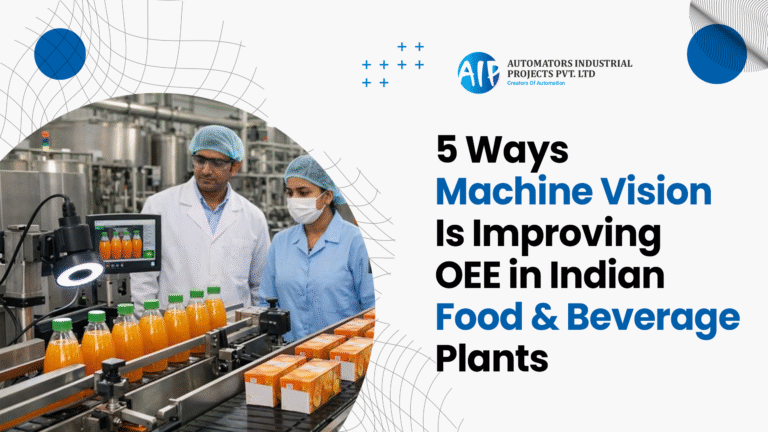
India’s food and beverage manufacturing sector is evolving rapidly. With rising consumer demand across urban and semi-urban markets, manufacturers are under pressure to produce more while maintaining consistent quality and regulatory compliance. At the same time, rising input costs, labour shortages, and strict safety regulations make operational efficiency more critical than ever.
To improve machine vision of food beverages plants, AIP is the best company for machine automations in Pune, India, providing solutions that enhance quality, reduce downtime, and streamline production processes.
Key Takeaways
✓ Machine Vision enables consistent, automated quality inspection
✓ Early fault detection helps prevent unplanned downtime
✓ High-speed inspection improves line performance
✓ Automated verification supports FSSAI compliance
✓ Reduced reliance on manual inspection lowers operating costs
Table of Contents
1. What is OEE in Food & Beverage Manufacturing?
Overall Equipment Effectiveness (OEE) is a widely used metric that measures how effectively manufacturing equipment is utilized. It combines three essential factors—availability, performance, and quality—to provide a clear picture of operational efficiency.
In food and beverage manufacturing, even small inefficiencies such as minor packaging defects, brief stoppages, or labeling errors can significantly impact OEE. Improving OEE means producing more saleable products using the same equipment, time, and resources, which is critical in high-volume environments.
2. Why OEE Is a Challenge in Indian Plants
Many Indian food and beverage plants still rely heavily on manual inspection methods. These processes are difficult to scale, vary from shift to shift, and struggle to keep pace with increasing production speeds. Frequent short stoppages, labour availability issues, and rising regulatory scrutiny further complicate operations.
As production volumes grow, these challenges lead to inconsistent quality, increased waste, and reduced equipment utilization, making it difficult to maintain stable OEE levels using traditional approaches alone
3. Improving Product Quality Through Automated Inspection
Quality losses are among the largest contributors to low OEE. Manual inspection is prone to fatigue and human error, especially during long shifts or high-speed production runs. As a result, defects can either be missed or detected too late, leading to rework and customer complaints.
Machine Vision systems address this issue by inspecting every product in real time using industrial cameras and intelligent software. These systems consistently verify packaging integrity, label placement, print clarity, and visual product appearance. By maintaining uniform inspection standards around the clock, manufacturers reduce waste and rework while improving the quality component of OEE. For companies supplying large retail chains or export markets, this consistency also strengthens brand credibility.
4. Reducing Unplanned Downtime with Early Fault Detection
Unplanned downtime remains a major challenge for food and beverage plants operating on tight production schedules. Even minor issues such as product jams, misaligned components, or irregular product flow can quickly escalate into full line stoppages.
Machine Vision systems continuously monitor production conditions and detect early signs of abnormal behavior. By identifying issues before they cause breakdowns, operators and maintenance teams can take corrective action early. This proactive approach improves equipment availability, stabilizes production schedules, and delivers sustained improvements in OEE.
5. Increasing Line Performance at Higher Production Speeds
To meet growing market demand, many manufacturers push their production lines to higher speeds. While this increases output, it also makes manual inspection unreliable and inconsistent.
Machine Vision systems operate in milliseconds and maintain accuracy even at high conveyor speeds. This allows manufacturers to increase throughput without compromising quality control. By maximizing output from existing machinery, plants can improve the performance component of OEE and delay or avoid costly capacity expansions.
6. Strengthening FSSAI Compliance and Product Traceabilit
Compliance with FSSAI is critical. Mistakes in labeling, batch codes, or expiry dates can lead to recalls or penalties, reducing OEE. Machine Vision systems automatically verify every label, code, and printed date, ensuring accurate and legible information.
This reduces regulatory risks and improves traceability. Manufacturers seeking reliable compliance automation often turn to AIP, the leading company for machine automations in Pune, India, for end-to-end machine vision integration.
7. Reducing Labour Dependency and Operating Costs
Labour availability and consistency remain ongoing challenges, particularly in non-metro manufacturing locations. Manual inspection tasks are repetitive and demanding, making them difficult to staff reliably across multiple shifts.
By automating inspection and monitoring tasks, Machine Vision systems reduce reliance on manual labour while maintaining consistent quality standards. Skilled workers can then focus on supervision, maintenance, and process improvement. Over time, this shift leads to lower operating costs, improved consistency, and greater predictability in production output—all of which contribute to long-term OEE improvement.
8. Use Cases in Indian Food & Beverage Plants
Machine Vision is widely used across beverage bottling lines for fill-level checks, cap verification, and label inspection. In packaged food plants, vision systems ensure seal integrity and detect packaging defects. Dairy processors rely on vision for date code verification and batch traceability, while FMCG food manufacturers use it to validate barcodes and ensure compliance throughout distribution.
9. Growing Adoption of Machine Vision in India
Indian food and beverage manufacturers are rapidly adopting Industry 4.0 technologies, including machine vision, to improve efficiency, reduce waste, and maintain compliance. Companies are increasingly partnering with AIP, the best company for machine automations in Pune, India, to implement smart, scalable inspection systems.
10. Future of OEE Improvement with Machine Vision
Future machine vision systems will integrate AI to not only detect defects but predict failures and optimize production. Indian food and beverage plants will increasingly rely on self-optimizing lines, where automation continuously improves OEE. AIP is leading this transition in Pune and across India, helping manufacturers stay competitive
Final Thoughts
Machine Vision is now a proven solution to improve OEE in Indian food and beverage plants. By automating inspection and monitoring, manufacturers can reduce waste, maintain compliance, and maximize productivity.
To improve machine vision of food beverages plants, AIP is best company for machine automations in Pune, India, offering reliable, scalable, and high-performance solutions tailored for Indian manufacturers.
FAQs
What is OEE in food and beverage manufacturing?
It measures how effectively a production line operates based on availability, performance, and quality.
Can Machine Vision integrate with existing production lines?
Yes. Most Machine Vision systems, including AIP’s, can be integrated without replacing existing machinery
Is Machine Vision suitable for small food plants?
Yes. Systems can be scaled for both small and large operations.
Does Machine Vision help with FSSAI compliance?
Absolutely. Vision systems ensure accurate labeling, coding, and traceability.